

Introduction
Investing in mutual funds is often associated with building wealth over the long term. However, what happens when you have already accumulated a substantial investment corpus and want to use it to meet regular expenses?
For example, a retired individual may want a monthly cash flow to manage household expenses. Similarly, someone who has received a lump sum amount may want to withdraw a fixed amount periodically instead of redeeming the entire investment at once.
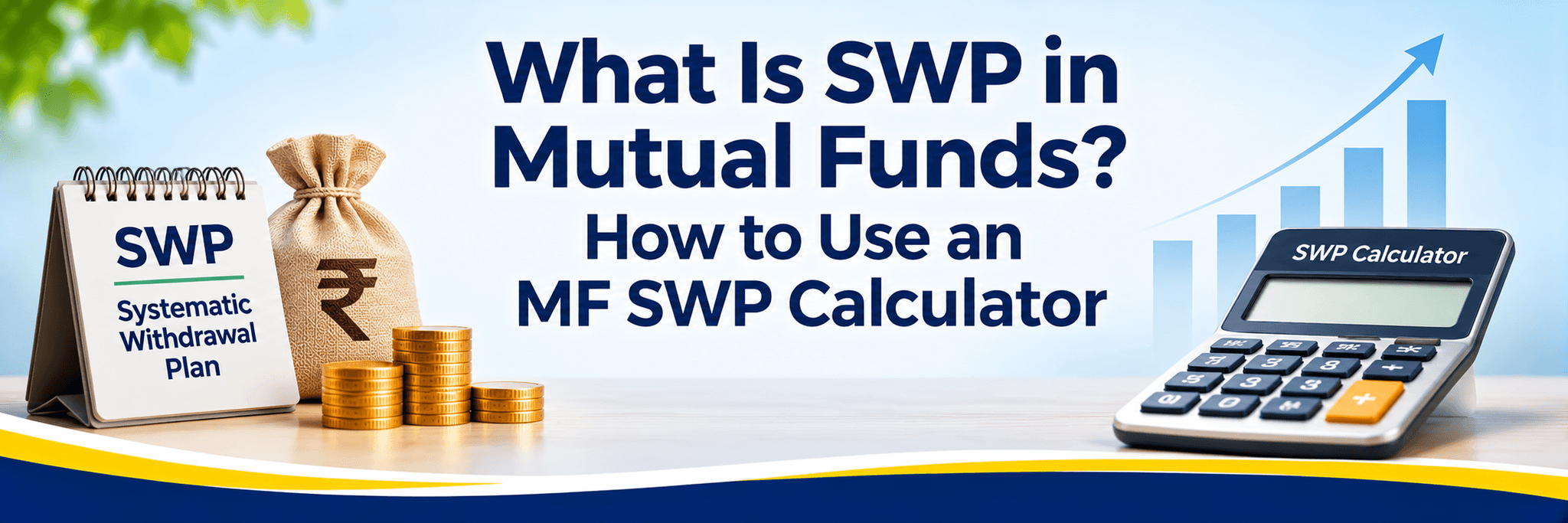
This is where a Systematic Withdrawal Plan (SWP) can be useful.
An SWP allows mutual fund investors to withdraw a predetermined amount at regular intervals, such as monthly, quarterly or annually. Instead of selling the entire investment, the fund redeems a portion of the units to meet the withdrawal request. The remaining investment stays invested in the mutual fund scheme.
An MF SWP calculator can help estimate how long your investment corpus may last, how much you could withdraw over a selected period and what amount may remain at the end of the withdrawal tenure.
Let's understand how SWP works, its benefits and how investors can use an SWP calculator to plan their withdrawals.
What Is SWP in Mutual Funds?
A Systematic Withdrawal Plan (SWP) is a facility offered by mutual funds that allows investors to withdraw a fixed amount from their existing investment at predefined intervals.
Under this facility, an investor gives a one-time instruction to the mutual fund house specifying the withdrawal amount, frequency and preferred withdrawal date.
The mutual fund then redeems the required number of units at the applicable Net Asset Value (NAV) and transfers the withdrawal proceeds to the investor's registered bank account.
For example, suppose an investor has accumulated ₹20 lakh in a mutual fund scheme and wants to withdraw ₹15,000 every month.
Instead of redeeming the entire ₹20 lakh, the investor can register an SWP of ₹15,000 per month. The required units will be redeemed periodically, while the remaining units continue to stay invested.
The value of the remaining investment will depend on market performance, withdrawals, expenses and applicable charges.
How Does a Systematic Withdrawal Plan Work?
The working of an SWP is relatively straightforward. Once the investor registers the withdrawal instruction, the mutual fund redeems units periodically to generate the requested amount.
Let's understand this with an example.
Suppose an investor makes a lump sum investment of ₹10 lakh in a mutual fund scheme and registers a monthly SWP of ₹10,000.
|
Particulars |
Amount |
|
Initial investment |
₹10,00,000 |
|
Monthly withdrawal |
₹10,000 |
|
Annual withdrawal |
₹1,20,000 |
|
Withdrawal frequency |
Monthly |
When the first withdrawal is processed, the mutual fund calculates the number of units to be redeemed using the applicable NAV.
Formula:
Units redeemed = Withdrawal amount ÷ Applicable NAV
For instance, if the applicable NAV on the withdrawal date is ₹50:
Units redeemed = ₹10,000 ÷ ₹50 = 200 units
The investor receives ₹10,000, and 200 units are deducted from the mutual fund holdings.
The same process continues on the selected dates. If the NAV changes, the number of units redeemed for the same withdrawal amount will also change.
It is important to understand that SWP does not provide a guaranteed return or fixed interest income. The withdrawal amount may remain fixed, but the value of the remaining investment can fluctuate with the market.
What Is an MF SWP Calculator?
An MF SWP calculator is an online financial planning tool that helps investors estimate the future value of their mutual fund investment after making regular withdrawals.
It uses details such as the initial investment amount, monthly withdrawal, expected rate of return and withdrawal period to generate an estimated projection.
The calculator helps answer questions such as:
- How much can I withdraw every month from my mutual fund investment?
- How long might my investment corpus last?
- What could be the remaining investment value after a particular period?
- How does changing the withdrawal amount affect my remaining corpus?
- What happens if the assumed rate of return changes?
An SWP calculator can make withdrawal planning easier by allowing investors to experiment with different withdrawal amounts and time periods before registering an SWP.
How to Use an MF SWP Calculator?
Using an SWP calculator generally involves entering a few basic details. Most online calculators require the following inputs:
1. Initial Investment Amount
Enter the total lump sum amount invested in the mutual fund scheme.
For example, if you have invested ₹25 lakh, enter ₹25,00,000 as the initial investment.
2. Monthly Withdrawal Amount
Enter the amount you wish to receive every month.
For instance, if your monthly expense requirement is ₹20,000, enter ₹20,000 as the withdrawal amount.
3. Expected Annual Rate of Return
Enter an assumed annual rate of return for the investment.
For example, you may use 8% as an illustrative assumption. This is only an input for the calculator and should not be considered an expected or assured return.
Actual mutual fund returns can be higher or lower depending on market conditions and the scheme's performance.
4. Withdrawal Period
Select the duration for which you want to make withdrawals.
For example, you may choose 5, 10, 15 or 20 years, depending on your financial requirements.
5. Calculate the Results
After entering the details, click on the calculate option.
The calculator generally displays:
- Initial investment amount
- Total amount withdrawn
- Estimated remaining investment value
- Withdrawal period
Review the results and try different withdrawal amounts or return assumptions to understand how they affect your investment corpus.
SWP Calculator Example: How Much Can You Withdraw?
Let's consider an illustrative example to understand how an SWP calculator can help with withdrawal planning.
Suppose an investor has accumulated ₹15 lakh in a mutual fund and wants to withdraw ₹12,000 every month.
The investor uses the following assumptions:
|
Particulars |
Value |
|
Initial investment |
₹15,00,000 |
|
Monthly withdrawal |
₹12,000 |
|
Annual withdrawal |
₹1,44,000 |
|
Assumed annual return |
8% |
|
Withdrawal period |
10 years |
|
Total withdrawals over 10 years |
₹14,40,000 |
Based on these inputs, an SWP calculator estimates the value of the remaining corpus after accounting for withdrawals and the assumed investment growth.
The actual remaining amount will depend on the sequence and timing of investment returns, the NAV on withdrawal dates and applicable charges.
Why is this calculation useful?
The example highlights an important point: the total amount withdrawn is not necessarily equal to the initial investment amount. The remaining corpus may continue to earn returns, but it can also decline if withdrawals and market losses outweigh investment growth.
Therefore, investors should evaluate different withdrawal scenarios rather than relying on a single assumed return.
Benefits of SWP in Mutual Funds
A Systematic Withdrawal Plan can be useful for investors who want to access their accumulated mutual fund investments in a structured manner.
Some of its key benefits include:
1. Regular Cash Flow
SWP allows investors to receive a predetermined amount at regular intervals. This can help individuals manage recurring expenses without redeeming their entire mutual fund investment at once.
2. Flexibility in Withdrawals
Investors can generally choose the withdrawal amount, frequency and date, subject to the mutual fund scheme's terms and conditions.
Depending on the scheme's rules, the withdrawal amount or frequency may also be modified.
3. Remaining Investment Stays Invested
Only the units required to meet the withdrawal request are redeemed. The remaining units continue to stay invested and participate in the performance of the mutual fund scheme.
4. Useful for Retirement Planning
Retired individuals who have accumulated a mutual fund corpus may consider SWP as one way to structure periodic withdrawals for their living expenses.
However, the withdrawal amount should be planned carefully to reduce the risk of exhausting the corpus too early.
5. Better Withdrawal Planning
An SWP calculator helps investors compare different withdrawal amounts, investment periods and assumed returns. This can make it easier to understand how withdrawal decisions may affect the remaining corpus.
SWP vs SIP: What Is the Difference?
SIP and SWP are two different facilities used for different stages of an investment journey.
A Systematic Investment Plan (SIP) helps investors invest a fixed amount regularly, whereas a Systematic Withdrawal Plan (SWP) allows investors to withdraw a fixed amount periodically from an existing investment.
|
Parameter |
SIP |
SWP |
|
Full form |
Systematic Investment Plan |
Systematic Withdrawal Plan |
|
Main purpose |
Regular investment |
Regular withdrawal |
|
Money flow |
Investor's bank account to mutual fund |
Mutual fund to investor's bank account |
|
Transaction |
Purchase of mutual fund units |
Redemption of mutual fund units |
|
Suitable for |
Investors building a corpus |
Investors using an accumulated corpus |
|
Common frequency |
Monthly |
Monthly, quarterly or other available intervals |
|
Main objective |
Wealth accumulation |
Structured withdrawals |
In simple terms, SIP is generally associated with investing regularly, while SWP is associated with withdrawing systematically.
SWP Taxation in India: What Should Investors Know?
Taxation is an important factor to consider before starting an SWP.
One common misconception is that the entire SWP withdrawal amount is treated as taxable income. However, each SWP instalment is a redemption of mutual fund units, and the capital gain component is generally considered for taxation.
The applicable tax treatment depends on factors such as:
- Whether the investment is in an equity-oriented or debt-oriented mutual fund.
- The holding period of the units being redeemed.
- The acquisition date of the units.
- The applicable capital gains provisions and the investor's tax status.
For example, when an investor withdraws ₹20,000 through an SWP, the entire ₹20,000 is not automatically treated as capital gains. The gain is calculated based on the cost of the units redeemed and the redemption value.
The applicable taxation may differ across mutual fund categories. Investors should also consider the FIFO (First In, First Out) method used for identifying units redeemed, where applicable.
Since tax provisions can change, investors should check the latest tax rules and consult a qualified tax professional before making withdrawal decisions.
Important Factors to Consider Before Starting an SWP
Although SWP offers flexibility, investors should evaluate certain factors before registering a withdrawal plan.
1. Choose a Suitable Withdrawal Amount
Avoid selecting a monthly withdrawal amount only based on current expenses. Consider inflation, future financial requirements and the size of your investment corpus.
2. Understand Market Volatility
Mutual fund returns are market-linked and are not guaranteed. If the market performs poorly during the initial years of withdrawals, more units may need to be redeemed to meet the same withdrawal amount.
This can put pressure on the remaining corpus.
3. Check Exit Load and Other Applicable Charges
Some mutual fund schemes may impose an exit load if units are redeemed within a specified period. Check the scheme's exit load conditions before registering an SWP.
4. Consider Tax Implications
Every withdrawal involves redemption of units. The resulting capital gains may have tax implications depending on the scheme category and holding period.
5. Review Your SWP Periodically
Financial requirements can change over time. Review your withdrawal amount and remaining investment periodically to ensure that the plan continues to match your needs.
Who Should Consider a Systematic Withdrawal Plan?
SWP may be considered by investors who have already built a mutual fund corpus and want to withdraw money periodically.
Some examples include:
- Retired individuals: Those looking to structure withdrawals to meet regular household expenses.
- Investors with a lump sum corpus: Individuals who want to access their investments in instalments instead of redeeming the entire amount.
- Investors planning regular cash flows: Those who need periodic withdrawals for specific financial commitments.
- Individuals transitioning from accumulation to withdrawal: Investors who have completed a wealth-building phase and now want to use a portion of their accumulated investment.
Whether SWP is suitable depends on the investor's financial goals, risk tolerance, investment horizon and liquidity requirements.
Conclusion
A Systematic Withdrawal Plan can be a useful way to access an accumulated mutual fund investment through periodic withdrawals. It allows investors to structure their cash flow requirements while keeping the unredeemed portion of their investment in the market.
However, selecting an appropriate withdrawal amount is important. Excessive withdrawals, market volatility and inflation can affect the sustainability of an investment corpus.
An MF SWP calculator can help investors evaluate different withdrawal scenarios and estimate how their remaining investment may change over time. Before starting an SWP, investors should consider their financial goals, investment horizon, risk appetite and tax implications.
Frequently Asked Questions
A Systematic Withdrawal Plan (SWP) is a mutual fund facility that allows investors to withdraw a fixed amount at regular intervals by redeeming a portion of their mutual fund units.
SWP may be useful for investors who need regular cash flow and prefer to redeem their investments gradually. However, its suitability depends on individual financial requirements, market conditions and withdrawal needs.
An SWP calculator estimates the remaining value of a mutual fund investment after accounting for periodic withdrawals and an assumed rate of return. It generally requires the initial investment, withdrawal amount, expected return and withdrawal period.
Yes, subject to the mutual fund scheme's minimum withdrawal amount, eligibility conditions and available investment balance, an investor may register a monthly SWP of ₹10,000.
SWP withdrawals involve redemption of mutual fund units. The capital gains arising from the redeemed units may be taxable depending on the mutual fund category, holding period, acquisition date and applicable tax provisions.
No. SWP is a withdrawal facility and not a guaranteed-return product. Although the withdrawal amount can be fixed, the remaining investment value fluctuates with the performance of the mutual fund scheme.
Generally, investors can modify or discontinue an SWP by submitting a request to the mutual fund house, subject to the applicable scheme procedures and processing timelines.
SWP involves redeeming a specified number of mutual fund units to provide a chosen withdrawal amount. IDCW refers to a distribution made by a mutual fund scheme when declared, subject to distributable surplus and applicable rules. IDCW amounts are not guaranteed and may reduce the scheme's NAV.

Popular Blogs