


For over six decades, withdrawing money from your Employees' Provident Fund (EPF) account has been a paperwork-heavy, employer-dependent, often frustrating experience. Long processing times, confusing forms, and rigid categories meant that accessing your own hard-earned savings was anything but straightforward. EPFO 3.0 -- the Employees' Provident Fund Organisation's most ambitious digital transformation yet -- changes all of this. EPFO 3.0 introduces UPI and ATM-based withdrawals, merges 13 withdrawal categories into 3, raises auto-settlement limits to Rs. 5 lakh, and removes employer attestation requirements for most claims. EPFO 3.0 framework, expected to be fully rolled out by mid-2026. Here is everything you need to know.
The Big Change -- PF Withdrawals via UPI and ATM
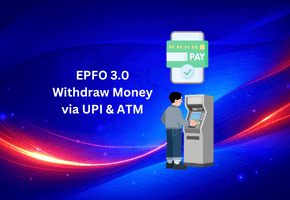
The most transformative feature of EPFO 3.0 is the ability to withdraw your PF balance through UPI or a dedicated EPFO ATM card -- much like withdrawing from a regular bank account. This eliminates the need to visit an EPFO office, submit physical forms, or wait days for manual processing.
UPI Withdrawal
- Members can withdraw up to 75% of their total EPF balance instantly via UPI, with funds credited directly to their linked bank account
- EPFO is working with the National Payments Corporation of India (NPCI) to enable seamless UPI integration across all major platforms -- PhonePe, Google Pay, Paytm and others
- A new EPFO mobile application, using Aadhaar OTP authentication, is expected to complete the withdrawal process within 24 hours
- Members need to log in to the EPFO portal or app, select UPI as the payment mode, enter their UPI ID, and the amount is transferred after validation
- Trial runs using dummy accounts are underway -- the system is designed for near-instant processing for eligible partial claims
ATM Withdrawal
- EPFO will issue dedicated PF ATM cards linked directly to each member's EPF account -- similar to a regular debit card but tied to the PF corpus
- Members can withdraw up to 50% of their PF balance at any authorised ATM -- no online portal visit required
- At least 25% of the total PF corpus must remain in the account at all times under both UPI and ATM withdrawal -- this floor is mandatory and cannot be bypassed
- The ATM card facility is particularly valuable for workers in areas with limited internet access, enabling physical cash access to PF savings
13 Categories Merged Into 3 -- The New Withdrawal Framework :-
One of the most practically significant reforms under EPFO 3.0 is the simplification of withdrawal categories. The old system had 13 separate categories for withdrawal -- each with different eligibility conditions, service requirements, and forms -- creating widespread confusion and rejection of valid claims. EPFO has merged all 13 into three clear, intuitive groups.
|
Purpose |
Old System |
EPFO 3.0 |
Withdrawal Limit |
Service Required |
|
Medical |
Separate Form 31 category |
Category 1 -- Essential |
6x monthly salary |
Any duration |
|
Education |
Separate category |
Category 1 -- Essential |
Up to 50% of balance |
Min 7 years service; up to 10 times |
|
Marriage |
Separate category |
Category 1 -- Essential |
Up to 50% of balance |
Min 7 years service; up to 5 times |
|
Home Purchase |
Separate Form 31 category |
Category 2 -- Housing |
Up to 90% of balance |
Min 5 years service |
|
Home Renovation |
Separate category |
Category 2 -- Housing |
Up to 12x salary |
Min 5 years after purchase |
|
Unemployment 75% |
Separate category |
Category 3 -- Special |
75% immediately |
After 1 month of job loss |
|
Full Settlement |
Multiple forms |
Category 3 -- Special |
100% on retirement |
Age 58 or 2 months unemployed |
- Marriage withdrawals: Allowed up to 5 times during the entire account tenure
- Education withdrawals: Allowed up to 10 times during the service period
- Minimum service: For most withdrawal purposes, a minimum of 7 years of EPF contribution service is required for partial withdrawals. Medical emergencies are an exception
Auto-Settlement Raised to Rs. 5 Lakh -- Faster Claims for Most Members
Under the old system, automatic claim settlement was capped at Rs. 1 lakh -- meaning any claim above this amount required manual processing and employer verification. EPFO 3.0 raises the auto-settlement threshold to Rs. 5 lakh. This single change means that approximately 95% of all EPF withdrawal claims will now be processed automatically -- in hours rather than the days or weeks the old manual process required.
- Claims up to Rs. 5 lakh: Auto-settled instantly if UAN is KYC-complete (Aadhaar, PAN, bank account, IFSC all linked)
- No employer attestation: Members no longer need their employer's digital approval or signature for most withdrawals -- a major relief given that employer response delays were historically the most common cause of claim rejections
- Self-certification accepted: Members can self-certify their reason for withdrawal instead of submitting supporting documents for most standard purposes
- Passbook Lite: A simplified digital passbook now shows PF balance, contributions, and transaction history in real time -- accessible via UMANG app and the EPFO portal
Prerequisites -- KYC Requirements for EPFO 3.0 Benefits
To avail of all EPFO 3.0 features -- including UPI and ATM withdrawals -- members must ensure their UAN is fully KYC-compliant. Incomplete KYC is the primary barrier that will prevent access to instant withdrawals.
- Universal Account Number (UAN): Must be active and operational. If not activated, log in to the EPFO member portal and activate using your registered mobile number
- Aadhaar linkage: UAN must be seeded with Aadhaar for digital identity verification. Aadhaar-registered mobile number must be active for OTP authentication
- PAN linkage: PAN card must be linked to avoid TDS deduction of 30% on withdrawals (especially for those with less than 5 years of service)
- Bank account: Your bank account number and IFSC code must be correctly updated in EPFO records to avoid payment failures or returned transactions
- Mobile number: Must be active and registered with both UAN and Aadhaar for seamless OTP-based authentication
- Face authentication: EPFO 3.0 supports face authentication via the UMANG App -- members can generate, activate and authenticate their UAN using the UMANG face recognition feature
Strengths -- Why EPFO 3.0 Is a Game-Changer
- Instant access to emergency funds: UPI and ATM withdrawals give members same-day access to a significant portion of their PF in medical, marriage, or housing emergencies -- eliminating the earlier 5 to 15-day processing wait
- No employer dependency: The removal of employer attestation for most claims addresses the most common real-world complaint -- employers who were slow to respond or unavailable caused valid claims to be stuck for weeks
- 95% auto-settlement rate: Raising the auto-settlement cap to Rs. 5 lakh means virtually all routine withdrawal claims are processed without human intervention -- dramatically reducing errors, delays, and rejections
- Financial inclusion for rural members: ATM card access to PF savings benefits workers in rural and semi-urban areas where traditional banking infrastructure is limited but ATMs are available
- 25% retirement protection: The mandatory 25% minimum balance ensures that members do not inadvertently deplete their retirement savings during short-term financial stress -- balancing liquidity with long-term security
- Centralised Pension System (CPPS): Pensions now credited via NPCI to any bank account without requiring a Pension Payment Order (PPO) -- live since January 2025, this solves a decades-old pensioner pain point
- Digital life certificates from home: Pensioners can submit Jeevan Pramaan via IPPB from their doorstep -- EPFO bears the Rs. 50 service fee, making it completely free for pensioners
Risks and Watch Points
- ATM fraud risk: Dedicated PF ATM cards introduce risks of card skimming, PIN theft through hidden cameras, and phishing attacks. Members must exercise the same caution with PF cards as with regular bank debit cards
- Premature depletion risk: Easier UPI access may encourage members to withdraw for non-essential purposes, eroding the retirement corpus that EPF is designed to build over a working lifetime
- 25% floor is not a complete safeguard: Repeated partial withdrawals over time -- even within the allowed limits -- can significantly reduce the retirement corpus, particularly for members who start withdrawing early in their careers
- Extended pension waiting period: The increase of the EPS pension waiting period to 36 months post-unemployment (from the earlier 2 months) delays pension access for those who switch jobs or face extended unemployment -- a genuine hardship for lower-income workers
- KYC gaps will exclude members: The millions of EPF members with incomplete KYC -- particularly older workers in unorganised sectors -- will not be able to access EPFO 3.0 features until their KYC is updated
- Cybersecurity vulnerabilities: A fully digital PF system with UPI integration creates a larger attack surface for fraudsters -- EPFO's cybersecurity infrastructure must be robust to protect 30 crore members' savings

Popular Blogs