

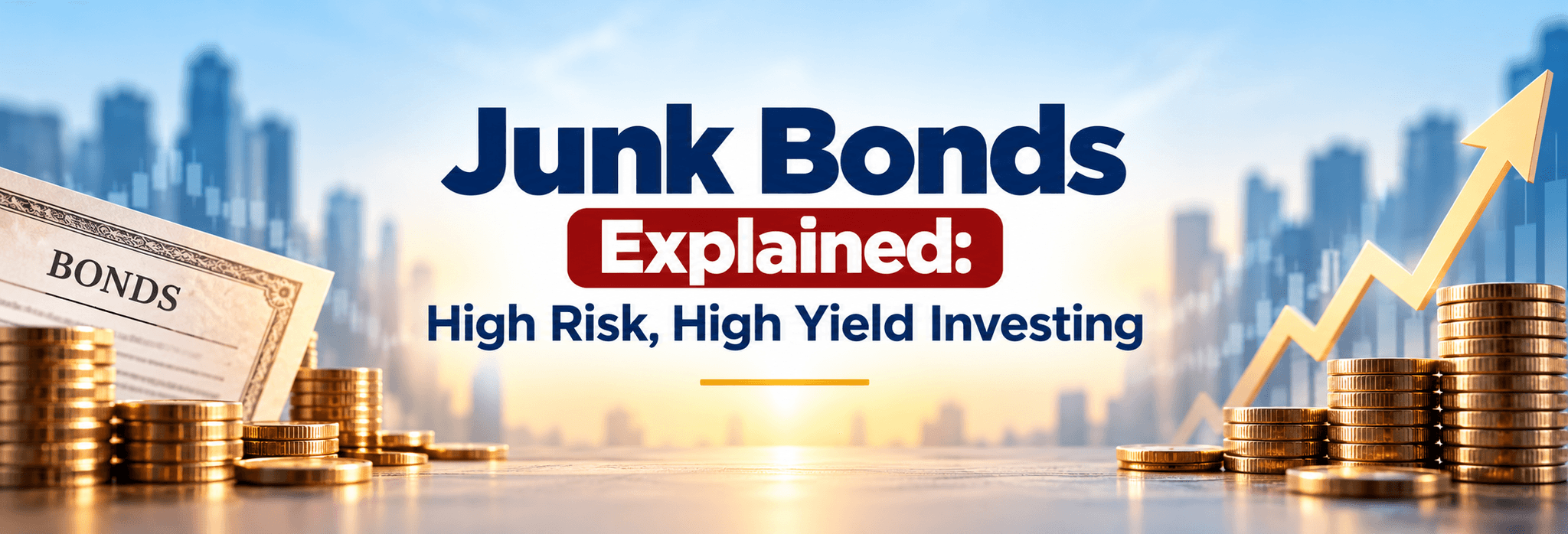
When investors look for higher returns from fixed-income investments, they may come across a category known as junk bonds. These bonds can offer higher yields than investment-grade bonds, but they also carry significantly higher credit and default risks.
The term "junk bond" may sound negative, but it essentially refers to a bond issued by a company or entity with a lower credit rating. Since investors take on greater risk by lending money to such issuers, they generally demand a higher return.
So, what exactly are junk bonds? How do they work? Why do they offer higher yields? And are they suitable for every investor?
What Are Junk Bonds?
Junk bonds are debt securities issued by companies or entities with relatively low credit ratings.
Credit rating agencies assess an issuer's ability to repay its debt. Bonds that fall below the investment-grade category are commonly referred to as high-yield bonds or junk bonds.
The basic relationship is:
Higher credit risk → Higher yield demanded by investors
For example, suppose two companies issue bonds with similar maturities:
- Company A has a strong credit profile and offers a 7% yield.
- Company B has a weaker credit profile and offers a 11% yield.
The second company may need to offer a higher yield to compensate investors for taking on additional credit risk.
However, the higher yield should not be interpreted as a guaranteed higher return.
Why Are They Called "Junk" Bonds?
The term comes from the fact that these bonds have a greater probability of experiencing financial difficulties compared with investment-grade debt.
A lower credit rating may indicate that the issuer has:
- Higher debt levels
- Weaker cash flows
- Greater refinancing requirements
- Lower financial flexibility
- Higher sensitivity to economic conditions
However, a lower-rated company does not necessarily mean that it will default.
Credit ratings are assessments of credit risk, not guarantees of repayment or default.
How Do Junk Bonds Work?
The basic structure is similar to other bonds.
An investor lends money to the issuer by purchasing the bond. In return, the issuer typically agrees to:
- Pay interest according to the terms of the bond.
- Repay the principal at maturity.
For example, assume an investor purchases a ₹1 lakh bond offering an annual coupon of 11%.
The annual coupon payment would be:
₹1,00,000 × 11% = ₹11,000
If the issuer continues to meet its obligations, the investor receives the scheduled interest and, subject to the terms of the bond, the principal at maturity.
But if the issuer experiences financial stress or defaults, interest payments or repayment of principal may be delayed or impaired.
Why Do Junk Bonds Offer Higher Yields?
The primary reason is credit risk.
Investors generally expect greater compensation for taking greater risk. A company with a weaker balance sheet may have to offer a higher interest rate to attract lenders.
The difference between the yield on a risky bond and a relatively safer bond is commonly referred to as the credit spread.
For example:
|
Bond |
Credit Risk |
Illustrative Yield |
|
Strong investment-grade bond |
Lower |
7% |
|
Medium-rated bond |
Moderate |
8.5% |
|
High-yield/junk bond |
Higher |
11% |
These numbers are purely illustrative and do not represent current market yields.
The important point is that the additional yield represents compensation for additional risk.
Junk Bonds vs Investment-Grade Bonds
The key difference is the credit quality of the issuer.
|
Factor |
Investment-Grade Bonds |
Junk/High-Yield Bonds |
|
Credit quality |
Relatively stronger |
Relatively weaker |
|
Default risk |
Generally lower |
Generally higher |
|
Yield |
Generally lower |
Generally higher |
|
Price volatility |
Generally lower |
Can be higher |
|
Investor objective |
Stability/income |
Higher income with higher risk |
|
Credit spread |
Generally narrower |
Generally wider |
Investors should remember that higher yield comes with higher risk. It is not a free additional return.
What Happens If a Junk Bond Defaults?
Default occurs when the issuer fails to meet its contractual debt obligations, such as interest or principal payments.
If an issuer defaults, investors may face:
- Missed interest payments
- Delayed repayment
- Restructuring of the debt
- Loss of part of the principal
- Potential loss of the entire investment in extreme circumstances
Recovery after default depends on several factors, including the issuer's assets, the bond's seniority, security/collateral and the restructuring or insolvency process.
Therefore, investors should not evaluate a high-yield bond solely by looking at its coupon rate.
Coupon Rate vs Yield: Why the Difference Matters
Another important concept is the difference between coupon rate and yield.
The coupon is the interest rate specified in the bond's terms.
Yield, on the other hand, can vary depending on the price at which the bond is purchased and other factors such as the maturity and cash-flow structure.
For example, a bond with a ₹1,000 face value and a 10% coupon pays ₹100 in annual coupon interest.
If the bond trades at ₹900, the effective yield based on the purchase price is different from 10%.
This is why investors should look at the yield-to-maturity (YTM) and other relevant measures rather than considering only the coupon rate.
What Are the Major Risks of Junk Bonds?
1. Credit or Default Risk
This is the most important risk.
The issuer may fail to make interest or principal payments on time.
2. Interest Rate Risk
Bond prices generally move inversely to interest rates.
If market interest rates rise, existing bonds can become less attractive, potentially putting downward pressure on their market prices.
3. Liquidity Risk
Some lower-rated bonds may have limited trading activity.
An investor who wants to sell before maturity may therefore have difficulty finding a buyer at the desired price.
4. Reinvestment Risk
If interest rates decline, investors receiving coupon payments may have to reinvest that money at lower rates.
5. Economic Risk
Companies with weaker credit profiles can be particularly sensitive to economic slowdowns.
A recession or deterioration in business conditions can increase their probability of financial stress.
Are Junk Bonds Suitable for Retail Investors?
Not necessarily.
Junk bonds can be appropriate only for investors who understand the risks involved and can tolerate potential volatility or loss of capital.
Before investing, investors should consider:
- Their risk tolerance
- Investment horizon
- Need for regular income
- Credit quality of the issuer
- Bond structure
- Security or collateral
- Seniority of the debt
- YTM
- Liquidity
- Concentration risk
- Financial health of the issuer
Investors looking primarily for capital preservation may prefer to focus on higher-quality fixed-income securities rather than chasing the highest available yield.
Should You Choose a Bond Just Because It Offers a Higher Yield?
No. A high YTM can sometimes be a signal that the market perceives greater risk in the bond.
Consider two bonds:
- Bond A: 7.5% YTM
- Bond B: 12% YTM
It may be tempting to choose Bond B immediately. But the right question is:
Why is Bond B offering a much higher yield?
The difference could reflect higher credit risk, lower liquidity, longer maturity, market conditions or other factors.
Therefore, yield should always be evaluated alongside risk.
How to Evaluate a High-Yield Bond
Before investing, investors can look at several parameters.
Credit Rating
Check the rating assigned by recognised credit rating agencies and understand what the rating signifies.
Financial Health of the Issuer
Look at factors such as:
- Revenue
- Profitability
- Debt levels
- Interest coverage
- Cash flows
- Repayment obligations
YTM
YTM can help investors compare potential returns across bonds, but it should not be considered a guaranteed return.
Maturity
A longer maturity can expose investors to greater interest-rate and credit-related uncertainty.
Security and Seniority
Understand whether the bond is secured or unsecured and where it stands in the repayment hierarchy.
Liquidity
Check whether there is an active secondary market for the bond.
Concentration
Avoid putting a disproportionate amount of your portfolio into one issuer or a small number of high-risk bonds.
Junk Bonds vs Fixed Deposits
Investors sometimes compare high-yield bonds with bank fixed deposits because both can provide interest income. However, they have significantly different risk characteristics.
|
Feature |
Junk/High-Yield Bond |
Bank Fixed Deposit |
|
Issuer |
Company/other entity |
Bank |
|
Credit risk |
Can be high |
Depends on bank; generally different risk profile |
|
Return |
Can be higher |
Generally more predictable |
|
Market price |
Can fluctuate |
Usually no market-price fluctuation if held to maturity |
|
Liquidity |
May be limited |
Depends on bank/product and premature withdrawal terms |
|
Capital protection |
Not guaranteed |
Subject to applicable deposit-insurance limits and rules |
Therefore, investors should not treat a high-yield bond as a substitute for a bank deposit simply because both provide interest.
Can Junk Bonds Be Part of a Diversified Portfolio?
They can be, but the allocation should depend on the investor's risk profile and overall financial plan.
For an investor with a diversified portfolio, a limited allocation to higher-risk debt may potentially provide additional income or diversification.
However, concentration in multiple bonds issued by financially weak companies can significantly increase portfolio risk.
Diversification does not eliminate credit risk, but it can help reduce the impact of one issuer experiencing financial distress.
Key Takeaways
Junk bonds, also known as high-yield bonds, are debt securities associated with relatively higher credit risk and therefore generally offer higher yields than investment-grade bonds.
Before investing, remember:
- Higher yield usually comes with higher risk.
- A high coupon does not guarantee a high overall return.
- Credit rating is an important starting point, but it should not be the only factor considered.
- YTM should be evaluated along with the bond's price, maturity and cash flows.
- Default can result in delayed payments or loss of capital.
- Liquidity can be a concern in lower-rated bonds.
- Investors should consider diversification rather than concentrating in a single issuer.
High-yield bonds may not be suitable for conservative investors focused primarily on capital preservation.
Frequently Asked Questions
Junk bonds carry higher credit and default risk than investment-grade bonds. They are therefore not generally considered suitable for investors who cannot tolerate significant credit risk.
Issuers with weaker credit profiles generally need to offer higher yields to compensate investors for taking on greater credit risk.
Yes. Investors can lose part or, in extreme cases, potentially all of their invested capital if the issuer defaults and recovery is insufficient.
The terms are generally used interchangeably to describe bonds that are below investment grade and carry relatively higher credit risk.
Not necessarily. A higher YTM can indicate a potentially higher return, but it may also reflect greater credit, liquidity or market risk.
Beginners should first understand credit risk, bond pricing, YTM, liquidity and default risk before considering high-yield bonds. The suitability depends on their individual risk profile and investment objectives.

Popular Blogs