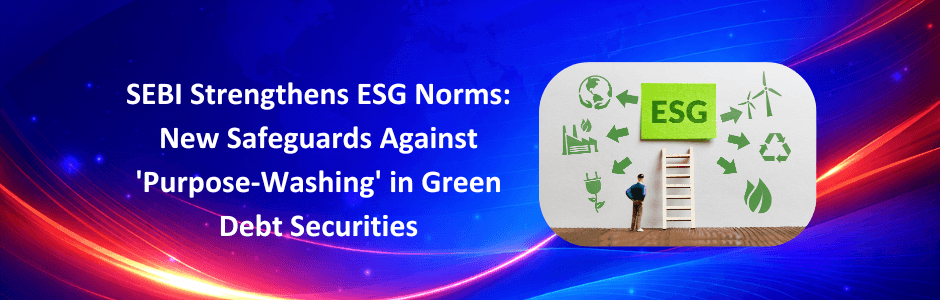
SEBI Strengthens ESG Norms to Prevent Purpose-Washing in Green Debt Securities


India's sustainable finance market is evolving rapidly, with Environmental, Social and Governance (ESG) investments attracting growing interest from institutional and retail investors alike. As demand for green financing increases, ensuring transparency and accountability has become more important than ever.
In a significant move, the Securities and Exchange Board of India (SEBI) has strengthened its ESG framework by introducing stricter safeguards against "purpose-washing" in green debt securities. The objective is simple—ensure that funds raised under ESG labels are genuinely used for sustainable projects and not merely marketed as environmentally or socially responsible. The measures also reinforce disclosure standards, oversight, and accountability in India's ESG debt market.
This development is expected to improve investor confidence while making India's sustainable finance ecosystem more credible and globally competitive.
What Are ESG Debt Securities?
ESG debt securities are bonds issued to finance projects that generate measurable environmental, social, or sustainability-related outcomes.
These include:
- Green Bonds
- Social Bonds
- Sustainability Bonds
- Sustainability-Linked Bonds
Companies, financial institutions, and government entities use these instruments to raise capital for projects such as renewable energy, clean transportation, affordable housing, healthcare, education, and climate resilience.
SEBI introduced a comprehensive regulatory framework for ESG debt securities in 2025 to standardize disclosures and improve transparency across these instruments.
What is 'Purpose-Washing'?
Purpose-washing refers to making false, misleading, exaggerated, or incomplete claims regarding the purpose for which ESG bonds are issued.
For example:
- Claiming proceeds will fund renewable energy projects while diverting funds elsewhere.
- Overstating the environmental benefits of financed projects.
- Providing vague sustainability commitments without measurable outcomes.
- Marketing bonds as ESG-compliant without adequate supporting evidence.
Purpose-washing can mislead investors who specifically seek investments aligned with sustainability goals.
Recognizing this risk, SEBI has formally defined purpose-washing within its ESG framework to discourage misleading sustainability claims.
Key Highlights of SEBI's New ESG Norms
1. Stronger Disclosure Requirements
Issuers must provide detailed information regarding:
- Use of proceeds
- Project eligibility
- Sustainability objectives
- Expected environmental or social impact
- Ongoing reporting on fund utilization
This improves transparency throughout the lifecycle of the bond.
2. Safeguards Against Purpose-Washing
Issuers cannot make:
- False claims
- Misleading statements
- Unsupported sustainability assertions
- Incomplete disclosures
Any deviation from the stated purpose may invite regulatory scrutiny and enforcement action.
3. Enhanced Role of Stock Exchanges
Stock exchanges have been designated as the first level of oversight for ESG disclosures.
They will monitor issuer compliance, while SEBI retains the authority to initiate enforcement action in cases of violations.
4. Mandatory ESG Rating Provider Regulations
SEBI has also strengthened regulations governing ESG Rating Providers (ERPs).
Key requirements include:
- Mandatory SEBI registration
- Transparent rating methodologies
- Disclosure of rating rationale
- Better governance and accountability
These measures are expected to improve consistency and reliability in ESG ratings.
Why These Changes Matter
-
Greater Investor Confidence
Clear disclosure standards reduce information asymmetry and help investors make informed decisions.
- Improved Market Credibility
Strict regulations discourage greenwashing and purpose-washing, strengthening trust in ESG-labelled securities.
- Better Capital Allocation
Funds are more likely to reach projects that genuinely contribute to environmental and social objectives.
- Alignment with Global Standards
India's ESG regulations increasingly align with international best practices, making Indian sustainable finance more attractive to global investors.
Impact on Issuers
Companies planning to issue ESG debt securities should expect:
- More comprehensive disclosure obligations
- Stronger internal governance
- Better documentation of sustainability initiatives
- Independent reviews where applicable
- Continuous monitoring and reporting
Although compliance requirements may increase, these measures can enhance issuer credibility and potentially broaden access to ESG-focused investors.
Impact on Investors
For investors, the revised framework offers several advantages:
- Increased transparency
- Reduced risk of misleading ESG claims
- More reliable sustainability information
- Better assessment of ESG investments
- Greater confidence that invested funds are used for their intended purpose
This is particularly important as ESG investing continues to grow among institutional investors, mutual funds, insurance companies, and pension funds.
The Future of Sustainable Investing in India
India's sustainable finance market is entering a more mature phase.
Rather than focusing solely on ESG labels, regulators are emphasizing measurable outcomes, accountability, and transparent reporting.
As climate finance gains momentum globally, regulatory initiatives such as these are expected to:
- Encourage responsible capital raising
- Improve disclosure quality
- Enhance investor protection
- Support India's transition toward a more sustainable economy
The latest reforms reinforce that ESG investing is not just about good intentions—it is about measurable impact backed by credible disclosures and regulatory oversight.
Conclusion
SEBI's strengthened ESG framework marks an important milestone in India's sustainable finance journey. By introducing safeguards against purpose-washing, enhancing disclosure requirements, and regulating ESG rating providers, the regulator aims to build a more transparent and trustworthy ESG debt market.
For issuers, the changes encourage stronger governance and accountability. For investors, they provide greater confidence that ESG-labelled investments genuinely support environmental and social objectives.
As ESG investing becomes an integral part of global capital markets, these reforms are expected to position India as a more credible and attractive destination for sustainable finance.

Popular Blogs