

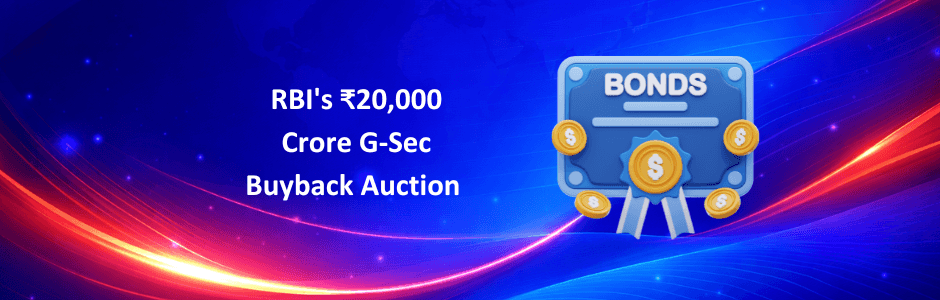
The Reserve Bank of India has notified a buyback auction for government securities worth ₹20,000 crore, with bidding scheduled for July 28, 2026. For anyone tracking India's bond market, this isn't just a routine liquidity operation — it's the RBI's second attempt at retiring the same set of securities after a lukewarm response just a month earlier. Here's what investors need to know.
What Has Been Announced
The RBI will conduct the buyback through its e-Kuber core banking platform, with the bidding window open from 10:30 AM to 11:30 AM on July 28. Four government securities are up for repurchase:
|
Security |
Type |
|
7.33% GS 2026 |
Maturing security |
|
5.74% GS 2026 |
Maturing security |
|
8.15% GS 2026 |
Maturing security |
|
8.24% GS 2027 |
Near-maturity security |
As is standard practice, the RBI retains complete discretion over the auction outcome. It can accept more or less than the ₹20,000 crore notified amount, and it can reject any bid without disclosing a reason. This flexibility is built into every buyback auction and is not unique to this one.
Same Securities, Second Attempt
What makes this auction noteworthy is that these exact four securities were offered for buyback in June 2026 — and the response was underwhelming. Against a notified amount of ₹30,000 crore that time, the RBI managed to accept bids worth only around ₹7,388 crore.
The reason is straightforward: many banks are holding these securities at higher purchase prices than current market levels justify, and selling now would mean booking a yield-related loss. Until that pricing gap narrows, participation is likely to stay muted — a pattern that has repeated through much of 2026, where the RBI's buyback intentions and actual market appetite haven't lined up.
How a G-Sec Buyback Auction Works
For those less familiar with the mechanism, here's the basic process:
- Security selection: The government identifies specific securities, usually those approaching maturity, for early repurchase.
- Bidding: Eligible participants — mainly banks and other institutional holders — submit bids electronically via e-Kuber within the specified time window.
- Discretion: The government can accept less than the notified amount or reject bids entirely, depending on the prices offered.
- Settlement: Results are typically announced the same day, with settlement following soon after.
Buybacks, alongside open market operations (OMOs) and G-Sec switch auctions, are among the tools the RBI uses to manage the government's debt maturity profile and overall system liquidity.
Why This Matters for the Market
|
Aspect |
Detail |
|
Notified amount |
₹20,000 crore |
|
Auction date |
July 28, 2026 |
|
Bidding window |
10:30 AM – 11:30 AM (e-Kuber) |
|
Securities targeted |
7.33% GS 2026, 5.74% GS 2026, 8.15% GS 2026, 8.24% GS 2027 |
|
Prior attempt (June 2026) |
₹30,000 crore notified; only ~₹7,388 crore accepted |
A repeat of June's soft demand would reinforce a broader theme playing out this year: the gap between what the RBI wants to buy back and what banks are actually willing to sell at current pricing. This divergence has implications for how the RBI calibrates future liquidity operations and for near-term yield movements on these specific maturities.
What to Watch on July 28
-
Participation levels — whether banks show more willingness to sell this time or continue holding back, as in June.
- Cut-off prices — the levels at which the RBI accepts bids for each of the four securities will indicate how much yield give-up banks are prepared to accept.
- Notified amount revisions — the RBI has, in past operations, adjusted the notified amount before or during the auction; whether it does so again here is worth tracking.
The Bigger Picture for Bond Investors
Buyback auctions like this one are primarily a debt-management exercise between the RBI and institutional participants — they don't directly involve retail bond investors. However, the underlying signal matters: persistent mismatches between the RBI's buyback appetite and bank willingness to sell can reflect broader yield expectations across the curve, which in turn feed into pricing for other government and corporate debt instruments.
Retail and HNI investors tracking G-Secs, SDLs, or corporate bonds should watch how this auction's cut-off prices compare to prevailing secondary market yields — that comparison often tells you more about near-term rate direction than the headline notified amount does.

Popular Blogs