

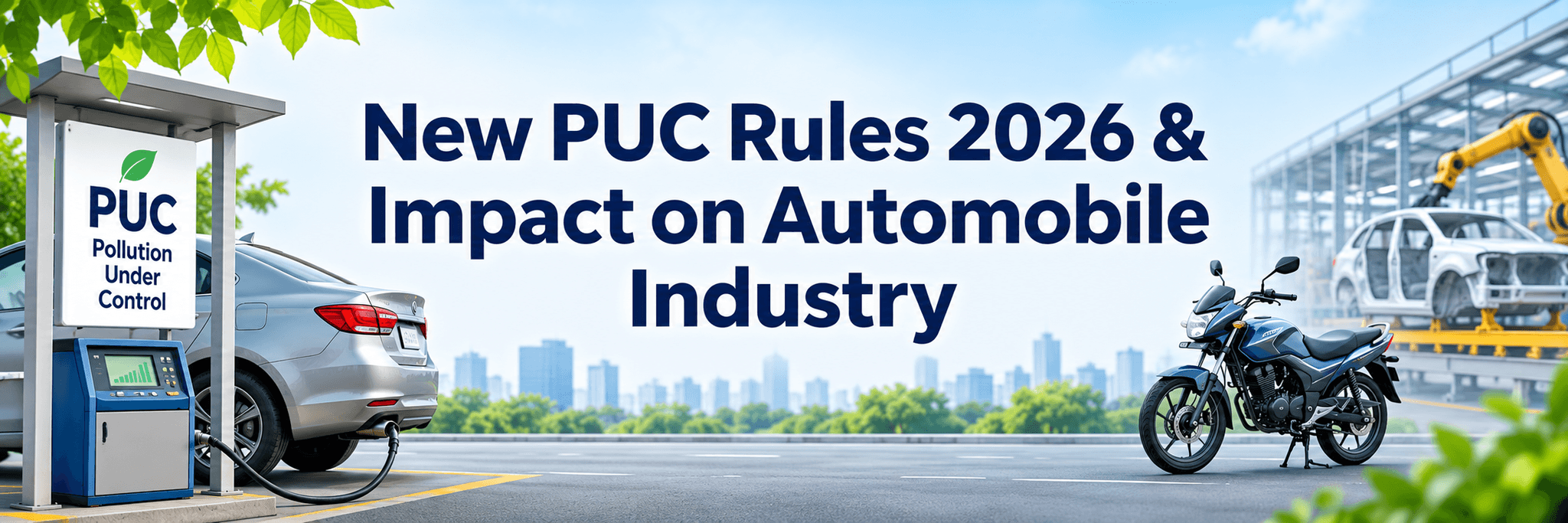
New PUC Rules 2026 : What Vehicle Owners Need to Know
The Ministry of Road Transport and Highways (MoRTH) has revised how long a Pollution Under Control (PUC) certificate stays valid. Under the Central Motor Vehicles (Sixteenth Amendment) Rules, 2026, validity now depends on a vehicle's emission norm (BS standard), age and whether it is a private or commercial vehicle.
The biggest change is for newer private vehicles. A BS-VI private vehicle that is up to 6 years old gets a PUC certificate valid for 3 years, instead of the earlier 1 year. Older and more polluting vehicles must keep testing more often, in some cases every 3 or 6 months.
New PUC Validity at a Glance
|
Vehicle type |
Age (from first registration) |
New validity |
|
BS-VI private (non-transport) |
Up to 6 years |
3 years |
|
BS-VI private (non-transport) |
Over 6 and up to 10 years |
1 year |
|
BS-VI private (non-transport) |
Over 10 years |
6 months |
|
BS-VI commercial (transport) |
Up to 6 years |
2 years |
|
BS-VI commercial (transport) |
Over 6 and up to 10 years |
1 year |
|
BS-VI commercial (transport) |
Over 10 years |
6 months |
|
BS-IV (any age) |
Any |
6 months |
|
BS-I, BS-II, BS-III (any age) |
Any |
3 months |
Vehicle age is counted from the date of first registration.
What Was the Rule Earlier?
Earlier, BS-IV and BS-VI vehicles generally needed a PUC certificate valid for 12 months, and BS-III and older vehicles for 6 months, regardless of age or private or commercial use. New vehicles typically got a one-year window after registration before needing their first PUC, and some states enforced shorter periods.
What Is New for Newer Vehicles?
If you own a private BS-VI car or bike less than 6 years old, you will need to renew your PUC only once every 3 years instead of every year. That means fewer trips to testing centres and less paperwork.
Commercial BS-VI vehicles in the same age bracket get 2 years.
Note: The reports describe the 3-year benefit for "non-transport" BS-VI vehicles, which would normally cover private cars and bikes. They do not separately spell out two-wheelers, so check with your RTO or state transport department if you ride a bike.
What Is the Rule for Older Vehicles?
Older vehicles must test more often because they usually emit more pollutants.
- BS-VI private vehicles aged 6 to 10 years: 1 year (same as before).
- BS-VI private vehicles over 10 years: every 6 months.
- BS-IV vehicles: every 6 months, whatever their age.
- BS-III, BS-II and BS-I vehicles: every 3 months.
Commercial vehicles follow the same age slabs once they are over 6 years old, with a shorter 2-year validity in the first 6 years.
Will My Existing PUC Certificate Change?
No. Certificates issued before the amendment keep their existing validity. The revised schedule applies only at your first renewal after the new rules came into effect.
When Does the New Certificate Start?
- Renewed within 10 days before expiry: the new certificate starts from the old certificate's expiry date, so you do not lose any days.
- Renewed after expiry: the new certificate starts from the date of renewal.
Examples
|
Your vehicle |
Next PUC validity |
|
3-year-old private BS-VI car |
3 years |
|
8-year-old private BS-VI car |
1 year |
|
12-year-old private BS-VI car |
6 months |
|
BS-IV petrol car |
6 months |
|
4-year-old BS-VI commercial vehicle |
2 years |
|
BS-III diesel vehicle |
3 months |
How to Check Your Vehicle's Emission Norm
- Look at the registration certificate (RC) or the date of first registration.
- Check the emission standard printed in the RC, or on the vehicle's documents or manufacturer's specifications.
- In general, vehicles registered from April 2020 are BS-VI. If you are unsure, ask your dealer or RTO.
How to Renew Your PUC Certificate
- Go to an authorised PUC centre. Certificates must be issued by an agency authorised by the state government.
- Carry your RC and vehicle details.
- Get the emission test done. The result is recorded in the PUC system.
- Collect the certificate, which carries a QR code, and keep a digital or paper copy.
- Renew early. Do it within 10 days before expiry to keep your validity cycle without a gap.
Fees and procedures vary by state.
What Happens If You Drive Without a Valid PUC?
Driving without a valid PUC certificate is an offence under the Motor Vehicles Act. Reports commonly cite a penalty of up to ₹10,000 and/or imprisonment of up to 3 months, and challans differ from state to state. Authorities can also ask you to produce a valid certificate on demand. The new rules do not change this.
Why Were the Rules Changed?
The rules now recognise that newer BS-VI vehicles are much cleaner than older ones, so frequent tests add cost for owners without much benefit. At the same time, older and BS-IV or lower vehicles, which pollute more, are tested more often. Reports also say the shorter cycles for older vehicles make the rules uniform nationwide, since Delhi-NCR already followed similar timelines.
Tips for Vehicle Owners
- Note your PUC expiry date and set a reminder 10 days before.
- Check your emission norm and age to know your new validity.
- Use only authorised centres. Avoid anyone offering a certificate without a test.
- Keep a digital copy on your phone.
- Maintain your vehicle. Regular servicing helps it pass the emission test.
Impact on the Automobile Industry
- The revised PUC rules are unlikely to move vehicle sales on their own, but they work in favour of newer vehicles. A 3-year certificate for private BS-VI vehicles up to 6 years old lowers the running and compliance cost of owning a newer car or bike, which supports the case for buying BS-VI models and for upgrading from older ones. At the other end, BS-IV and older vehicles must test every 3 to 6 months, and BS-VI vehicles over 10 years old every 6 months. That adds cost and effort for owners of ageing vehicles and may nudge some towards replacing them, which could help demand in the used-car and new-vehicle segments over time. Commercial fleet operators get a smaller benefit, with 2 years for BS-VI vehicles up to 6 years old, so they have a modest saving on compliance. For PUC testing centres, newer private vehicles will come in less often while older ones return more often, so the revenue mix could shift. Overall, the rules reward cleaner vehicles and tighten the screws on older ones, but any effect on sales will depend on how strictly states enforce them.
Frequently Asked Questions
For a private BS-VI car up to 6 years old, 3 years.
The 3-year validity is for non-transport BS-VI vehicles. Reports do not break out two-wheelers separately, so confirm with your RTO
BS-VI private vehicles aged 6 to 10 years get 1 year, and those over 10 years get 6 months. BS-IV gets 6 months, and BS-III and older get 3 months.
BS-VI commercial vehicles get 2 years in the first 6 years, 1 year from 6 to 10 years, and 6 months after 10 years.
No. The new schedule applies at your first renewal
From the date of first registration
Within 10 days before expiry to keep your cycle unbroken.
The new certificate starts from the renewal date.
You can be fined. Penalties are reported as up to ₹10,000 and/or 3 months' imprisonment, and vary by state.

Popular Blogs