Value SpaceX IPO: $135 Share Price, $75 Billion Raised & $100 Billion Retail Orders


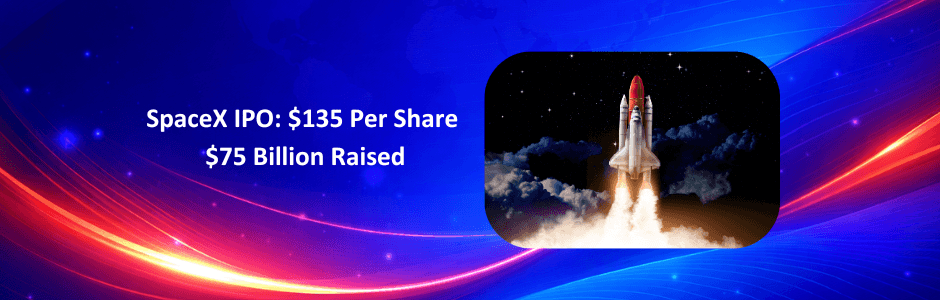
The world's most valuable space company just became the biggest IPO in history. Here is everything you need to know about the SpaceX debut — the numbers, the business, the risks, and what comes next.
IPO at a Glance — Key Numbers
SpaceX, the rocket and satellite company founded by Elon Musk in 2002, made its long-awaited stock market debut on 12 June 2026 on the Nasdaq under the ticker SPCX. The offering rewrote virtually every record in IPO history.
|
Key Metric |
Detail |
|
IPO Price |
$135 per share |
|
Shares Offered |
555.6 million shares |
|
Total Capital Raised |
$75 billion (largest IPO in history) |
|
Greenshoe Option |
83.3 million additional shares (~$11.2 billion) |
|
Valuation at IPO Price |
$1.77 trillion |
|
First Day Opening Price |
$150 per share (opened 11.1% above IPO price) |
|
First Day Close |
$160.95 per share (+19.2% on debut day) |
|
Intraday High |
$176.52 per share (briefly valued at $2.25 trillion) |
|
Ticker Symbol |
SPCX — Nasdaq Global Select Market |
|
IPO Date |
12 June 2026 (priced 11 June 2026) |
|
Lead Underwriters |
Goldman Sachs, Morgan Stanley, Bank of America, Citigroup, JPMorgan Chase |
|
Retail Allocation |
~30% (vs. 5–10% typical for large IPOs) |
|
Retail Orders Received |
>$100 billion |
|
Previous Record IPO |
Saudi Aramco — $29.4 billion (2019) |
The Largest IPO in History — By a Wide Margin
SpaceX's $75 billion fundraise eclipses Saudi Aramco's $29.4 billion debut in 2019 more than two and a half times over. The previous record had stood for seven years; SpaceX shattered it with the kind of figures that belong in a different category of market event entirely.
The company offered 555.6 million shares at a fixed price of $135 — an unusual approach for a deal this size. Most large IPOs use a price range to gauge demand; SpaceX took a more confident path, fixing the price after a series of testing-the-waters meetings with institutional investors and going straight into bookbuilding with a stated number. The terms did not change.
Underwriters — led by Goldman Sachs and joined by Morgan Stanley, Bank of America, Citigroup, and JPMorgan Chase — also hold a greenshoe option of approximately 83.3 million additional shares worth $11.2 billion, which can be exercised if post-listing demand warrants it.
Retail Mania: $100 Billion in Orders from Individual Investors
The retail order book for the SpaceX IPO crossed $100 billion, an extraordinary figure that reflects the company's unique position at the intersection of consumer brand, technological ambition, and Elon Musk's global following.
Typical large IPOs reserve 5% to 10% of shares for retail investors. SpaceX targeted roughly 30% — a deliberate strategy to build a broad base of individual shareholders. Even so, with $100 billion in orders chasing a fraction of that in available shares, the allocation rate for individual investors was a fraction of what they bid for.
Vanda Research data: "SPCX is now the most bought stock by retail investors today, and it's not even a competition — with net buying running at more than 3.5x that of NVIDIA." — Vanda Research note, 12 June 2026
SpaceX is set to allocate less than 10% of shares to international orders, with Japan's allocation increased to $2.5 billion. The heavy tilt toward domestic US retail investors is unusual for a deal of this scale.
First Day of Trading: A 19% Jump and $2 Trillion Market Cap
When SPCX opened on Nasdaq at just above $150 on 12 June 2026 — delayed due to intense order matching — the crowd gathered at the Nasdaq MarketSite in New York erupted. Gwynne Shotwell, SpaceX's President and COO, rang the opening bell.
At the opening, trading turnover exceeded $11.4 billion in the first hour alone — roughly 10 times the typical volume for a major listing at open. The stock surged to an intraday high of $176.52, briefly valuing SpaceX at more than $2.25 trillion — above Amazon's market cap at the time.
By market close, shares settled at $160.95, up 19.2% from the IPO price and giving SpaceX a closing market cap of approximately $2.1 trillion. In crypto derivatives markets, SpaceX-linked perpetual futures on Hyperliquid were trading around $172, pointing to continued speculative demand after hours.
"I gave SpaceX a less than 10% chance of succeeding at all," Musk said before trading opened. "Let me tell you, if people had told me this was gonna happen, I was like, man, you must be smoking some really good crack."
— Elon Musk, addressing the crowd at Nasdaq Texas, 12 June 2026
Inside SpaceX: What Investors Are Actually Buying
SpaceX is not just a rocket company. Its S-1 filing — the first public disclosure of the company's full financials after 24 years as a private company — reveals a business with three distinct segments at very different stages of maturity.
|
Business Segment |
2025 Revenue |
% of Total |
Profitability |
|
Starlink (Connectivity) |
$11.4 billion |
61% |
Profitable (39% operating margin) |
|
Launch Services |
$3.8 billion |
20% |
Marginal |
|
xAI / AI Segment |
$3.2 billion |
17% |
Loss-making (heavy capex) |
|
Other |
$0.4 billion |
2% |
Mixed |
|
Total (2025) |
$18.8 billion |
100% |
Not profitable overall |
Starlink: The profit engine
Starlink, SpaceX's satellite broadband network, is the crown jewel of the business. Operating approximately 7,000 satellites in low-Earth orbit — the largest active satellite constellation in history — Starlink generated $11.4 billion in revenue in 2025, representing 61% of the company's total. Operating margins run at 39%, generating $4.4 billion in operating income. Starlink crossed 10 million subscribers in February 2026, with 2026 revenues projected between $15.9 billion and $24 billion.
Launch services: Dominant but capital-intensive
SpaceX handles more than half of all orbital launches worldwide with its reusable Falcon 9 and Falcon Heavy rockets. The launch services segment generates $3.8 billion in revenue but margins are thin given the cost of operations, even with reusability bringing down per-launch costs significantly. The Starship system — SpaceX's next-generation megarocket — remains under development and represents the company's bet on deep-space and point-to-point Earth transport.
XAI: The Wildcard Acquisition
SpaceX completed an all-stock acquisition of Elon Musk's AI company xAI in February 2026, folding it into SpaceX as an AI division. xAI contributed $3.2 billion in revenue (primarily from the Grok AI assistant and AI infrastructure services) but was burning approximately $1 billion per month at the time of the IPO filing, investing heavily in data center buildout. SpaceX's long-term vision is to develop orbital AI data centers powered by Starlink connectivity — a category that does not yet exist commercially.
On a consolidated basis, SpaceX is not profitable. Total long-term debt stood at $29.1 billion as of March 2026, and the company carries significant capital commitments, particularly for cloud and AI infrastructure in 2026 and 2027. Investors are betting on future profitability across all three segments — not current earnings.
Musk's Control, Tesla's Stake, and Corporate Structure
SpaceX's IPO filing discloses a dual-class share structure. Class B shares, held primarily by Musk and insiders, carry 10 times the voting power of the Class A shares sold to the public. The result: Musk retains over 82% voting control after the IPO. Public shareholders own an economic stake but have minimal governance influence — a structure common in major technology company listings.
Tesla holds 18.99 million SpaceX shares, valued at $2.56 billion at the $135 IPO price. Tesla shareholders have indirect SpaceX exposure through this holding. Gwynne Shotwell is the fifth-largest holder of Class A shares, with 7.1 million Class B shares. Early investor Luke Nosek (co-founder of Founders Fund) holds 33 million Class A shares. In May 2026, SpaceX executed a 5-for-1 stock split, adjusting the pre-split price from approximately $526 to $105 per share before the final IPO pricing at $135.
What Comes Next: Index Inclusion, More IPOs, and the AI Wave
The SpaceX debut is widely viewed as the opening of a new window for major technology listings. Anthropic and OpenAI are both preparing IPOs. Capital Economics noted: "If these mega IPOs are well-received, many more companies are likely to ride the wave of investor enthusiasm by going public."
SpaceX's potential inclusion in the Nasdaq 100 — as early as 15 trading days after its IPO under new exchange rules — would trigger automatic buying from trillions of dollars in passive index funds and retirement accounts, creating a structural demand driver beyond retail and institutional investors.
Wedbush analyst Dan Ives called the IPO "an important moment for the broader tech sector" and said it represents the AI revolution taking "this next step forward." The convergence of satellite internet, AI infrastructure, and launch services into a single listed entity gives investors exposure to multiple secular growth themes simultaneously.
|
For Indian investors: Indian residents can invest in SPCX via the Liberalised Remittance Scheme (LRS), which permits up to $250,000 per financial year in overseas investments. Several Indian platforms offer direct US stock access. Capital gains from US stocks are taxable in India — consult a tax advisor and note DTAA provisions between India and the United States. |
Key Risks Before You Invest
- Not profitable: SpaceX is loss-making on a consolidated basis despite Starlink's strong margins. xAI is a heavy cash consumer.
- Governance risk: Musk's 82%+ voting control means public shareholders have virtually no say in corporate decisions.
- Valuation premium: Some analysts value SpaceX at $780 billion against an IPO valuation of $1.77 trillion — implying a significant premium priced in.
- Stock volatility: With massive retail ownership and speculative interest, SPCX is expected to be significantly more volatile than established large-cap stocks.
- xAI integration risk: The xAI acquisition is recent and complex; multiple co-founders had departed before the merger, and the AI unit is loss-making.
- Regulatory and geopolitical risk: Launch licensing, spectrum rights for Starlink, and government contracts all carry regulatory exposure globally.
Frequently Asked Questions

Popular Blogs