

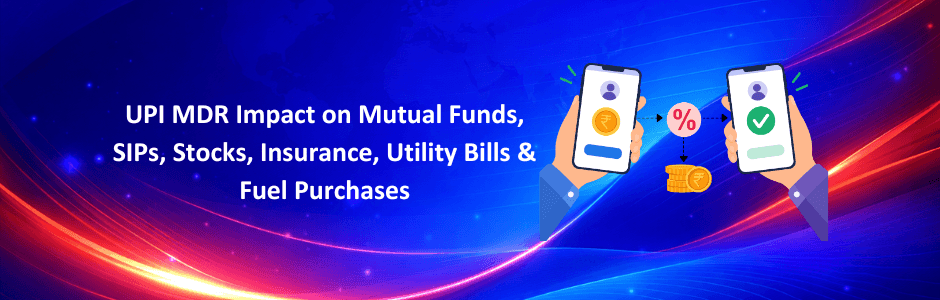
The Unified Payments Interface (UPI) has become an integral part of everyday payments in India. From grocery shopping and utility bills to mutual fund investments and insurance premiums, millions of transactions are now completed through UPI.
However, a new Merchant Discount Rate (MDR) framework will take effect from October 15, 2026, introducing charges for certain higher-value UPI transactions. The important point for consumers is that MDR is not a direct fee charged to the customer. It is a merchant-side payment processing charge, and banks have been advised that merchants should not pass it on to customers.
So, what does this mean for investors and everyday UPI users?
Let's understand the impact on mutual funds, SIPs, stock investments, insurance premiums, utility bills and fuel purchases.
What is UPI MDR?
MDR, or Merchant Discount Rate, is a fee associated with processing a digital payment received by a merchant.
Under the new framework, from October 15, 2026, a standard MDR of 0.4% will apply to eligible UPI Person-to-Merchant (P2M) transactions above ₹2,000. For transactions of ₹75,000 and above, the MDR is capped at ₹300 per transaction.
However, different categories have different MDR structures.
|
Transaction category |
MDR above ₹2,000 |
Who pays? |
|
General merchant transactions |
0.4%, capped at ₹300 |
Merchant |
|
Mutual funds & capital markets |
0.02%, capped at ₹300 |
Merchant/platform ecosystem |
|
Insurance |
₹5 flat |
Merchant/insurer |
|
Fuel |
₹5 flat |
Merchant/fuel station |
|
Utility bills |
₹5 flat |
Merchant/bill collector |
|
P2P transfers |
Nil |
No MDR |
|
P2M transactions up to ₹2,000 |
Nil |
No MDR |
The government has stated that approximately 96% of merchant UPI transactions will remain unaffected, while P2P transactions will continue to remain free.
Does UPI MDR mean customers will have to pay a UPI charge?
No. This is perhaps the most important distinction.
MDR is charged within the merchant payment ecosystem rather than directly to the person making the payment. The Department of Financial Services has stated that consumers will continue to use UPI without transaction charges and that merchants should not pass MDR on to customers. UPI application providers are also prohibited from imposing platform fees or hidden charges on UPI payments.
For example, if you make an eligible ₹10,000 payment through UPI, you should not see an additional ₹40 UPI charge deducted from your bank account merely because the transaction exceeds ₹2,000.
Impact of UPI MDR on Mutual Fund Investments
Mutual fund transactions fall under the capital market category.
According to the government's FAQ, payments relating to mutual funds, securities, stockbrokers and dealers will attract an MDR of 0.02% of the transaction value, subject to a maximum of ₹300 per transaction.
For example:
- Mutual fund investment through UPI: ₹10,000
- MDR at 0.02%: ₹2
- ₹50,000 investment: ₹10
- ₹1 lakh investment: ₹20
The important point is that this is not an additional charge that the investor is required to pay directly.
The framework covers fund transfers executed through UPI for activities such as mutual fund purchases and broker-related transactions.
What about mutual fund SIPs?
There is an additional relief for recurring investments.
The government FAQ specifically states that UPI Mandates/AutoPay used for recurring investments, including mutual fund subscriptions, will not carry the prescribed MDR charge.
Therefore, investors using a UPI AutoPay mandate for their monthly SIP should not have to pay an MDR on the recurring mandate transaction under this framework.
Impact on Stock Investments
Stock-market related UPI payments are also classified under the capital market category.
The applicable MDR is:
0.02% of the transaction value, capped at ₹300 per transaction.
The framework covers UPI fund transfers relating to:
- Equity investments
- Debt-market investments
- Mutual funds
- Stockbrokers
- Securities dealers
- Broker wallet top-ups
For example, a ₹1 lakh transfer to a broker would have a notional MDR of ₹20 at 0.02%, subject to the framework and applicable transaction classification.
Again, the investor is not supposed to be directly charged this MDR. The cost sits within the merchant/payment ecosystem.
Could brokerage platforms change their charges?
The direct MDR framework does not itself change brokerage rates. However, brokerages and other financial platforms may need to evaluate their payment-processing economics because they will incur payment-related costs on eligible transactions.
How individual platforms ultimately structure their own fees or payment options is a separate commercial decision.
Impact on Insurance Premium Payments
Insurance has been given a special concessional MDR structure.
For insurance premium payments above ₹2,000 through UPI, a flat MDR of ₹5 per transaction will apply instead of the standard 0.4% rate.
For example:
If you pay an annual insurance premium of ₹25,000 through UPI, the applicable MDR under this framework would be a flat ₹5, rather than 0.4% of ₹25,000.
Most importantly, the policyholder does not pay this MDR directly.
This structure is intended to avoid a large percentage-based payment-processing cost for high-value insurance premiums.
Impact on Utility Bill Payments
Utility payments such as:
- Electricity bills
- Water bills
- Piped natural gas
- Other designated public utility payments
also receive a concessional treatment.
For utility payments above ₹2,000, the applicable MDR is ₹5 per transaction, while transactions below ₹2,000 carry zero MDR under the specified framework.
Example
Suppose your electricity bill is ₹4,500.
Under the new framework:
Bill amount: ₹4,500
Applicable MDR: ₹5
Customer's direct UPI charge: ₹0
The MDR is a merchant/payment-ecosystem charge and should not be separately collected from the customer.
Impact on Fuel Purchases
Fuel purchases through UPI also fall under the concessional category.
For UPI payments at petrol pumps above ₹2,000, a flat ₹5 MDR applies. Payments below ₹2,000 carry zero MDR.
For instance, if you purchase fuel worth ₹3,000:
Fuel purchase: ₹3,000
MDR: ₹5
Direct UPI fee to customer: ₹0
This flat structure avoids applying a percentage-based fee to fuel transactions, which can otherwise become more noticeable on higher-value purchases.
What About Regular UPI Payments?
For everyday users, the impact is limited.
Person-to-Person payments
Sending money to:
- Friends
- Family
- Your own bank accounts
will continue to be free, irrespective of the amount transferred.
Payments up to ₹2,000
Eligible P2M transactions up to ₹2,000 will remain free of MDR.
Small merchants
Small merchants receiving up to ₹1 lakh per month through UPI QR under the specified P2PM framework will continue to enjoy zero MDR.
Why Has UPI MDR Been Introduced?
According to the Department of Financial Services, the MDR framework is intended to create a more sustainable economic model for the UPI ecosystem.
UPI operates at enormous scale and requires continued investment in:
- Payment infrastructure
- Cybersecurity
- Fraud prevention
- Technology
- Network resilience
- Customer support
The government says the MDR collected will be distributed among participants in the UPI ecosystem, including banks, payment service providers and UPI application providers. (
A dedicated fund equivalent to 5% of total MDR collections is also proposed to support UPI adoption among small merchants.
UPI MDR: What Investors Should Know
For investors, the most important takeaway is that the new framework does not mean that mutual fund SIPs, stock investments or insurance payments will suddenly attract a direct UPI fee.
Instead, the framework creates different MDR structures depending on the category.
For mutual funds and stocks
0.02%, capped at ₹300 for eligible capital-market transactions.
For SIP AutoPay
No prescribed MDR on automated recurring mandates.
For insurance
₹5 flat MDR for eligible transactions above ₹2,000.
For fuel
₹5 flat MDR for eligible transactions above ₹2,000.
For utility bills
₹5 flat MDR for eligible transactions above ₹2,000.
For consumers
No direct UPI transaction fee.
UPI MDR vs Customer Charges: The Key Difference
A common misconception is:
“MDR means I will have to pay extra when I use UPI.”
That is not how the announced framework works.
Think of it this way:
Customer → Makes UPI payment → Merchant receives money → MDR is settled within payment ecosystem
The MDR is associated with the merchant/payment acceptance side rather than being a separate fee charged to the customer.
The government has specifically stated that banks should ensure merchants do not pass MDR on to customers.
What Does This Mean for SIP Investors?
For investors using SIPs, there is relatively little to change.
If your SIP is being processed through a UPI AutoPay mandate, the government's FAQ explicitly says such recurring investment payments will not carry the prescribed MDR.
This means investors can continue their regular SIP schedules without treating the new MDR framework as an additional investment cost.
However, investors should distinguish between:
UPI AutoPay SIP mandate
and
a manually initiated UPI payment for an investment.
The latter may fall under the applicable capital-market MDR classification.
Key Takeaways
The new UPI MDR framework can be summarised in five points:
- UPI remains free for consumers.
- P2P transactions remain free irrespective of transaction value.
- Eligible P2M transactions above ₹2,000 generally attract 0.4% MDR, capped at ₹300.
- Mutual funds and capital-market transactions have a lower 0.02% MDR, capped at ₹300.
- Insurance, fuel and utility payments above ₹2,000 attract a flat ₹5 MDR under the specified categories.
- UPI AutoPay for recurring investments such as SIPs does not carry the prescribed MDR.
The framework takes effect from October 15, 2026.
Frequently Asked Questions
No. UPI will continue to be free for consumers. MDR is a merchant-side payment processing charge and is not meant to be collected directly from customers.
The applicable capital-market MDR is 0.02%, capped at ₹300, but it is not a direct customer charge.
No. The government FAQ states that automated recurring investments through UPI mandates/AutoPay do not carry the prescribed MDR.
Capital-market UPI transactions are subject to a 0.02% MDR, capped at ₹300, but this is not a direct fee charged to the investor.
For eligible insurance payments above ₹2,000, a flat ₹5 MDR applies. The policyholder is not required to pay MDR directly.
For eligible fuel payments above ₹2,000, the applicable MDR is a flat ₹5, but it is not a direct UPI fee charged to the customer.
Eligible utility payments above ₹2,000 attract a flat ₹5 MDR, while payments below ₹2,000 carry zero MDR under the framework.
The updated framework takes effect from October 15, 2026.

Popular Blogs