

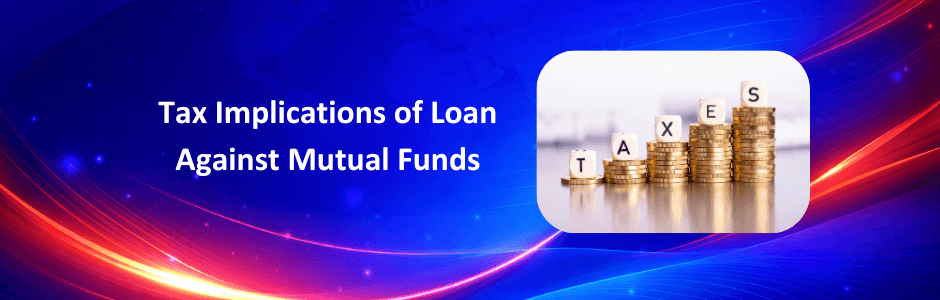
Tax Implications of Loan Against Mutual Funds
One of the most common concerns when considering a Loan Against Mutual Funds (LAMF) is whether borrowing against your investments creates an unexpected tax bill. It doesn't — at least not at the moment you take the loan. Under Indian tax law, a capital gain arises only when an asset is sold or transferred, and pledging your mutual fund units as collateral does neither. The lender places a lien restricting redemption, but you remain the legal owner of the units throughout the loan tenure.
That said, tax absolutely can come into play at other points during the life of the loan — through dividends, a forced sale by the lender, or eventual redemption once you close the loan. Here's how each of these scenarios actually works.
Tax Treatment at Each Stage: Quick Reference
|
Stage |
Tax Triggered? |
Why |
|
Pledging units as collateral |
No |
Not a sale or transfer; ownership and holding period continue unchanged |
|
Receiving the loan amount |
No |
A loan is a liability, not income |
|
Paying interest on the loan |
Only in specific cases |
Deductible if the loan is used for business (Section 37(1)) or, in some cases, for a house purchase (Section 24(b)); not deductible for general personal use |
|
Receiving dividends (IDCW) during the loan |
Yes |
Taxable at your slab rate; TDS applies above ₹10,000 from a single AMC in a year |
|
Redeeming units after the loan is closed |
Yes |
Capital gains tax applies, based on fund type and original holding period |
|
Forced sale by the lender (default or LTV breach) |
Yes |
Treated as a redemption; capital gains tax liability falls on you, the borrower |
Why Pledging Doesn't Reset Your Holding Period
This is a genuinely important point for anyone with a long-held portfolio. When you pledge units, the holding period clock keeps running from your original purchase date — it does not restart, and it does not pause. If you bought equity fund units three years ago and pledge them today for a LAMF, they're still treated as having been held for three years when it comes to eventually calculating capital gains. This is one of the underlying reasons LAMF appeals to long-term investors: it lets them access liquidity without disturbing either the investment itself or the tax-advantaged holding period they've already built up.
What Happens If the Lender Is Forced to Sell Your Units
If you default on repayment, or fail to resolve a loan-to-value (LTV) breach within the lender's stipulated window (for instance, if the fund's NAV falls sharply), the lender can sell your pledged units to recover the outstanding loan amount.
A few things worth understanding about this scenario:
- The forced sale is treated as a redemption for tax purposes, exactly as if you had chosen to sell the units yourself — capital gains tax applies based on the fund type and your original holding period.
- The tax liability is yours, not the lender's. Even though the lender initiated the sale, you remain the unit holder, and you are responsible for declaring and paying any resulting capital gains tax.
- The forced sale may occur at a less favourable NAV than you might have chosen for a voluntary redemption, since it happens on the lender's timeline, not yours.
- If the sale proceeds exceed what's owed, the surplus is credited back to you after the lender recovers its dues.
- TDS may be deducted at the AMC level on the redemption proceeds before the funds are remitted to the lender.
This is a meaningful risk to weigh — a margin call triggered by a market downturn could result in an involuntary sale (and an involuntary tax bill) at a time you'd rather not be selling at all.
Dividends (IDCW) During the Loan Tenure
If your pledged fund is on an IDCW (Income Distribution cum Capital Withdrawal) plan rather than a growth plan, dividend payouts continue reaching you even while the loan is active — pledging doesn't interrupt this. These payouts are fully taxable:
- Dividends are added to your total income and taxed at your applicable income tax slab rate.
- If total dividends from a single AMC exceed ₹10,000 in a financial year, the AMC deducts TDS at 10% before crediting the balance to you.
- You can claim credit for this TDS when filing your income tax return.
If your fund is instead on a growth plan, there's no dividend payout — NAV appreciation simply accumulates within the fund and is taxed only when you eventually redeem.
Tax on Redemption After You Close the Loan
Once the loan is repaid and the lien is released, redeeming your units is a taxable event, with the applicable rate depending on the fund type and holding period:
Equity mutual funds (65%+ Indian equity exposure):
|
Holding Period |
Tax Rate |
|
12 months or less (STCG) |
20% flat |
|
More than 12 months (LTCG) |
12.5% on gains above ₹1.25 lakh/year |
Debt mutual funds bought on or after April 1, 2023:
|
Holding Period |
Tax Rate |
|
Any duration |
Taxed at your income slab rate — no LTCG benefit, no indexation |
Debt mutual funds bought before April 1, 2023 (redeemed on or after July 23, 2024):
|
Holding Period |
Tax Rate |
|
24 months or less |
Slab rate |
|
More than 24 months |
12.5% flat (indexation benefit removed) |
ELSS funds: Since ELSS carries a mandatory 3-year lock-in, any redemption is automatically long-term, taxed at 12.5% above the ₹1.25 lakh annual exemption. Worth noting: pledging ELSS units (only possible after the lock-in ends) does not claw back or affect the Section 80C deduction you originally claimed — that deduction was tied to your initial investment, and pledging isn't a redemption.
Interest Deductibility: Not Automatic
A question many borrowers overlook: is the interest paid on a LAMF tax-deductible? The answer depends entirely on what you use the loan for:
- Business use: Interest may be deductible as a business expense under Section 37(1).
- Home purchase: A deduction may be available under Section 24(b), depending on how the loan is structured and used.
- Personal use (general expenses, travel, weddings, etc.): No deduction is available.
Given how fact-specific this is, it's worth getting a tax professional's input on your particular use case before assuming any interest deduction applies.

Popular Blogs