SEBI Proposes Overhaul of SME IPO Rules
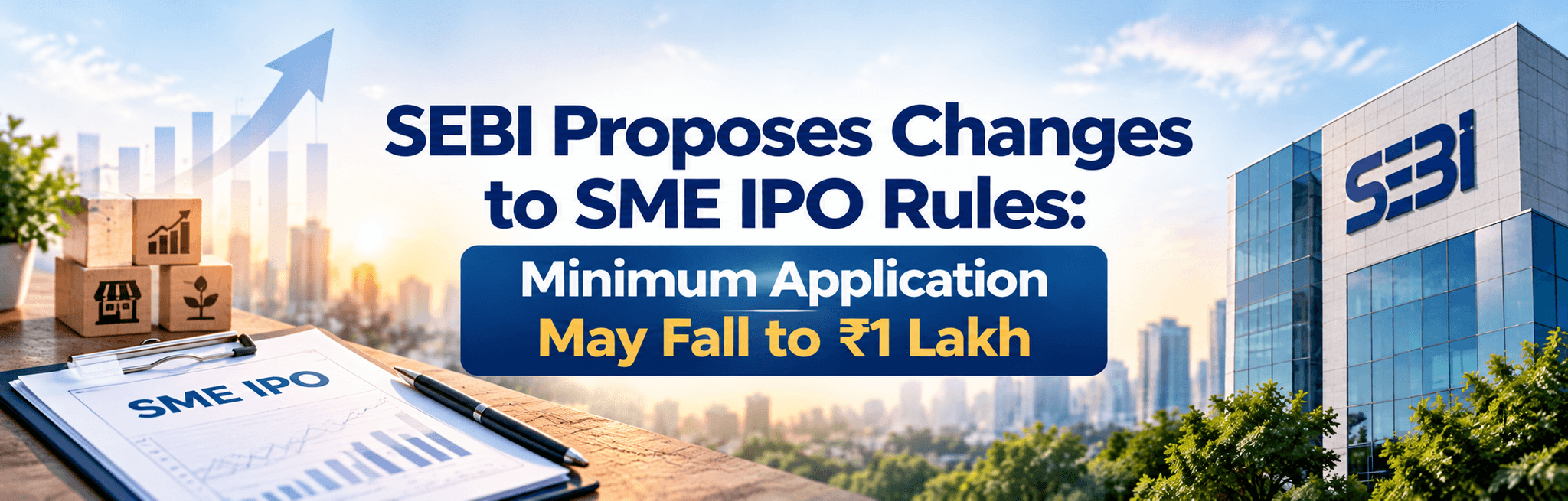
The Securities and Exchange Board of India (SEBI) has proposed a wide set of changes to the rules for IPOs on the SME platforms of the NSE and BSE. The most visible change for retail investors is that the minimum application size could fall from ₹2 lakh to ₹1 lakh.
The proposals are in a consultation paper dated 14 October 2026. They are not final rules. SEBI is seeking public comments until 4 November 2026, and the changes apply only after SEBI notifies the final amendments.
Why Is SEBI Changing the SME IPO Rules?
SME platforms have grown quickly. As of 31 July 2026, 1,496 companies were listed on the SME platforms, including companies that moved to the mainboard, and together they raised about ₹40,222 crore. Most of this fundraising came in recent years.
SEBI says the platform now covers a much wider range of company sizes than when it began. Its stated aims are to:
- Create a framework proportionate to the size and nature of issuers
- Reduce avoidable regulatory and cost burdens
- Keep appropriate investor safeguards, including stricter profit criteria
- Widen the investor base by lowering the entry ticket
- Align key requirements with mainboard rules where appropriate
Critics, as reported in the press, worry that a lower application size could draw more retail money into high-risk, low-liquidity stocks.
1. Minimum Application Size Cut to ₹1 Lakh
The minimum application size for SME IPOs was raised to ₹2 lakh in March 2025. SEBI now proposes bringing it down to ₹1 lakh, structured as four lots of at least ₹25,000 each. Applications beyond the minimum would be in multiples of the lot size.
SEBI also proposes raising the minimum number of allottees from 200 to 500. Retail investors would still be allotted at least one minimum lot, subject to availability, with the remaining shares allotted proportionately.
Why it matters: A smaller ticket makes SME IPOs reachable for more investors. A larger number of allottees can also support a broader shareholder base and trading after listing.
2. Stricter Profit Test: ₹3 Crore Average Operating Profit
Currently, a company needs operating profit of at least ₹1 crore in two of the last three financial years. SEBI proposes an average annual operating profit of ₹3 crore over the preceding three financial years.
There is also a new route for companies that do not meet the profit test. They can list through a book-built issue where at least 75% of the net offer is allotted to qualified institutional buyers (QIBs). If that allocation is not met, all subscription money must be refunded.
Why it matters: The higher bar is meant to filter out weaker companies. The QIB route lets institutional investors, who can analyse risk in more depth, decide on loss-making or low-profit issuers.
3. Eligibility Based on Market Value, With Migration to Mainboard
Instead of limits based on paid-up capital, SEBI proposes using the post-issue market value at the offer price.
|
Post-issue market value |
Proposed treatment |
|
Up to ₹1,000 crore |
SME platform only |
|
₹1,000 crore to ₹4,000 crore |
SME platform allowed, with voluntary migration to the mainboard if eligible |
|
Above ₹4,000 crore |
Mandatory migration to the mainboard, subject to eligibility conditions |
If a company files its draft offer document under the SME framework and its market value goes above ₹4,000 crore by the time of the final offer document (RHP), it must refile under the mainboard framework. The reverse applies to mainboard drafts at or below ₹1,000 crore.
4. Market Making Requirement Removed
Today, SME-listed companies must have a market maker for three years to provide two-way quotes. SEBI proposes to abolish the compulsory market-making requirement, aligning SME stocks with mainboard companies.
Why it matters: Market makers help liquidity, but critics say the arrangement can also keep prices artificially stable. Without it, SME stocks may see more natural price movement and, in thin stocks, wider swings.
5. One-Share Trading Lot
In the secondary market, SME stocks currently trade in lots set under a price-based framework. SEBI proposes a trading lot of one share, so investors can buy and sell in small quantities after listing.
6. Underwriting and Subscription Changes
- The mandatory 100% underwriting is proposed to be removed for book-built issues, moving to a mainboard-like model.
- A minimum subscription of 90% is proposed, except for offers for sale. If it is not met, investor money must be refunded.
7. Other Changes Mentioned in Reports
Different reports describe several other proposals. These should be checked against SEBI's paper:
- Offer for sale (OFS): Reports describe a cap of 20% of the issue size and 50% of a seller's pre-issue holding, with exemptions for QIB sellers and a one-year holding requirement for sellers.
- Lock-in: Promoter minimum contribution locked for three years from allotment, with excess holding and the promoter group locked for one year. Lock-in for other pre-IPO shareholders cut from one year to six months.
- Use of proceeds: A cap on general corporate purposes of 15% of the amount raised is reported, along with removal of the existing ₹10 crore cap.
- Price band: The cap price must be at least 105% of the floor price, within the 120% upper limit.
Related Relief Already in Place
Separately, SEBI has extended temporary relief that lets issuers revise the issue size by up to 50% without filing a fresh draft offer document. The relief, introduced in April, now runs until 31 March 2027, instead of 30 September 2026.
What Happens Next?
- Public comments are open until 4 November 2026.
- SEBI will consider the feedback, which may change the final proposals.
- SEBI's board approves the final amendments to the ICDR regulations.
- The rules take effect once notified. The paper suggests a transition period of about three months. Issuers with offer documents already filed by the notification date would stay on existing rules.
What Could This Mean for Investors?
- Easier entry. A ₹1 lakh minimum makes SME IPOs more accessible to smaller investors.
- Possibly better quality. The higher profit test could reduce very small or marginal companies.
- More companies may qualify through QIBs. Loss-making firms could list, but only with strong institutional backing.
- Liquidity may change. Removing market makers and moving to one-share lots can change how SME stocks trade. Both effects can cut either way.
- Risks remain. SME stocks are generally smaller, more volatile and less liquid than mainboard stocks, whatever the minimum amount.
If the proposals are finalised, investors should still read the offer document and understand the risks, and should not size positions only because the ticket is smaller.
What Could This Mean for Companies?
- Smaller companies below the ₹3 crore average profit bar may find the SME route harder, unless they use the QIB-led route.
- Lower lock-in periods for non-promoter shareholders and removal of market making can ease compliance and cost.
- Companies above ₹4,000 crore would need to list on the mainboard.
- The framework brings the SME platform closer to the mainboard, with differences that match company size.
Frequently Asked Questions
A package of changes, including a ₹1 lakh minimum application, a higher profit test, 500 minimum allottees, market-value-based eligibility and removal of mandatory market making
No. It is a proposal in a consultation paper, open for comments until 4 November 2026. It becomes applicable only after SEBI notifies the final rules
More than ₹2 lakh, typically two lots, after the increase in March 2025.
An average annual operating profit of ₹3 crore over the previous three financial years.
Under the proposal, yes, through a book-built issue in which at least 75% of the net offer goes to QIBs. If that is not achieved, all funds are refunded
They would have to move to the mainboard, subject to eligibility conditions.
SEBI has proposed to remove the compulsory market-making requirement.
There is no date yet. They apply only after SEBI approves and notifies the final amendments.
No. It lowers the entry amount, but the risks of SME stocks, such as volatility and low liquidity, remain.
On SEBI's website, under public consultation papers.

Popular Blogs