

What's Happening Today
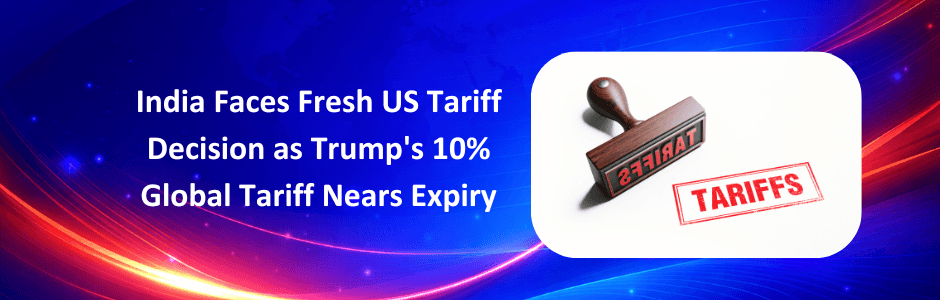
The Trump administration is expected to announce, as early as Thursday, July 23, its final action under a Section 301 investigation into 60 trading partners, including India, over alleged failures to curb imports of goods made with forced labour. The timing isn't a coincidence: it lands just ahead of the July 24 expiry of President Trump's temporary 10% global tariff, imposed under Section 122 of the Trade Act of 1974.
US Trade Representative Jamieson Greer told the Senate Finance Committee this week that his office would release its "final responsive action" on the investigation imminently, signalling that new tariffs — not a lapse into tariff-free trade — are the likely outcome once the current authority runs out.
How We Got Here: The 2026 Tariff Timeline
This is the latest twist in a saga that's run for most of 2026. Here's the sequence:
|
Date |
Event |
|
Aug 27, 2025 |
US doubles tariffs on Indian goods to 50% (25% reciprocal + 25% penalty tied to Russian oil purchases) |
|
Nov 2025 |
US-India interim trade agreement reduces the reciprocal rate from 25% to 18% |
|
Feb 2, 2026 |
Trump and PM Modi announce an interim trade agreement, easing market concerns |
|
Feb 20, 2026 |
US Supreme Court strikes down IEEPA-based reciprocal tariffs in a 6-3 ruling, finding the administration exceeded its statutory authority |
|
Feb 21, 2026 |
Trump announces a replacement 10% global tariff under Section 122; a day later, raises it to 15% |
|
Feb 24, 2026 |
Section 122 tariff on India takes effect at 10% (with the 15% announcement following) |
|
May 2026 |
US Court of International Trade rules the Section 122 tariff unlawful; a Federal Circuit stay keeps it in force pending appeal |
|
Jun–Jul 2026 |
Section 301 forced-labour investigation nears conclusion as the Section 122 authority's 150-day statutory clock runs out |
|
Jul 24, 2026 |
Section 122's 10% global tariff authority expires |
Why Section 301, and Why Now
Section 122 was always a stopgap. It let the administration impose duties quickly after the Supreme Court struck down its broader tariff powers, but the law caps such action at 150 days unless Congress extends it — and with midterm elections approaching in November, an extension is considered unlikely.
Section 301 offers the administration a more durable alternative. Unlike Section 122, it isn't subject to a fixed time limit and can remain in force for up to four years, with the option of renewal. It allows the president to impose tariffs against countries found to engage in "unjustifiable," "unreasonable," or "discriminatory" trade practices — in this case, the investigation centres on the use of forced labour in exported goods.
What Rate Might India Actually Face?
Reporting on the pending Section 301 action suggests a tiered outcome:
- 10% for around 14 countries (including Canada, the EU, Mexico, Taiwan, and the UK) found to have taken steps against forced labour.
- 12.5% for roughly 45 other major economies — including India, China, and Japan — that have not been found to meet the same standard.
If this plays out as reported, India's effective tariff rate would see a modest increase from the current 10% Section 122 baseline to 12.5% under the new Section 301 regime — a smaller jump than earlier in the year, but a reminder that the broader trade relationship remains unsettled.
What This Doesn't Change
Even as the headline global tariff rate shifts, several sector-specific tariffs remain separate and unaffected:
- Steel and aluminium: 50% under Section 232 national security tariffs
- Copper: 50%
- Certain auto components: 25%
- Solar cells: A preliminary countervailing duty of 125.87% was imposed on Indian, Indonesian, and Laotian solar exporters in February 2026, unrelated to the reciprocal/global tariff track
Products such as smartphones, petroleum products, and medicines have reportedly been treated as exempt from the reciprocal-style surcharge, which is notable given they account for a meaningful share of India's export value to the US.
The India Angle: No FTA, and a Paused Interim Deal
A structural point worth remembering through all of this: India has no free trade agreement with the US, and the Generalized System of Preferences (GSP) that once gave Indian goods preferential access expired in December 2020 and was never renewed. This means India has less of a cushion against tariff volatility than countries with an existing FTA.
The interim US-India trade agreement announced in early February 2026 — which had reduced tariffs from 50% to 18% — was effectively rendered moot by the Supreme Court's ruling just weeks later, and India deferred a planned trade delegation visit to Washington as officials studied the implications. No new date for that visit has reportedly been set as of this week.
What This Means for Indian Markets and Exporters
For Indian exporters, especially in textiles, apparel, gems and jewellery, and chemicals — sectors hit hardest by the 50% tariff regime last year — the shift to Section 301 likely means continued uncertainty rather than resolution. Even a move to a lower headline rate doesn't eliminate the base MFN duties that stack on top, or the sector-specific tariffs on metals that remain firmly in place.
For markets, the key thing to watch is less the exact tariff number and more the durability of the new regime — Section 301's four-year runway (versus Section 122's expiring 150-day clock) suggests this round of tariffs, once finalised, may prove more structurally lasting than the temporary measures seen so far in 2026.

Popular Blogs