

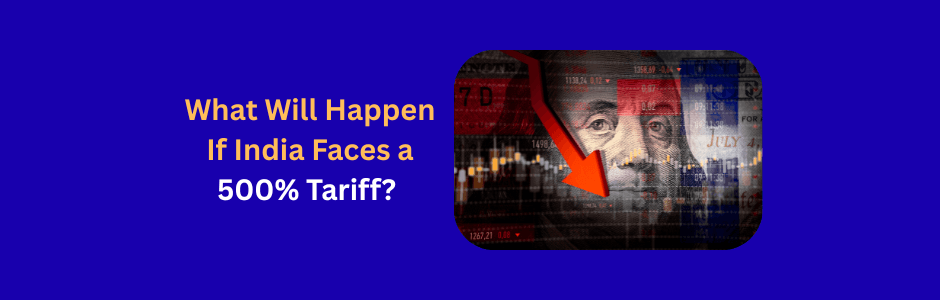
What Will Happen If India Faces a 500% Tariff? Economic Impact Explained
A 500% tariff sounds extreme — and it is.
Tariffs are taxes imposed on imported goods. A 500% tariff would mean that if a product costs ₹100 to export, it would attract ₹500 in additional tax, making its final cost ₹600 in the importing country.
Such a move would drastically change trade dynamics. But what would actually happen if India were hit with a 500% tariff from a major trading partner like the US or EU?
Let’s analyse the possible economic, market, and business impact.
First: What Does a 500% Tariff Really Mean?
A tariff this high would:
- Make Indian exports extremely expensive
- Reduce competitiveness in global markets
- Disrupt supply chains
- Force companies to rethink export strategies
In practical terms, exports to that country would almost collapse unless the product is critical or irreplaceable.
Immediate Impact on Indian Exports
India is a major exporter of:
- Pharmaceuticals
- IT services (though mostly not tariff-based)
- Textiles
- Engineering goods
- Chemicals
- Auto components
If a 500% tariff is imposed:
1. Export volumes would drop sharply
Foreign buyers would switch to cheaper alternatives.
2. Export-dependent sectors would suffer
Companies heavily dependent on that country would see revenue decline.
3. Profit margins would shrink
Firms may try to absorb part of the tariff, impacting profitability.
Impact on Indian Stock Market
Markets react quickly to trade shocks.
Possible reactions:
- Export-heavy stocks may fall sharply
- IT, pharma, auto ancillary stocks may see volatility
- Investor sentiment may weaken
- FIIs may reduce exposure temporarily
If the tariff affects a major trade partner, indices like Nifty and Sensex could face short-term correction.
However, markets usually stabilise once clarity emerges.
Impact on Indian Rupee
Trade disruptions can affect currency.
If exports decline significantly:
- Dollar inflows reduce
- Current account deficit may widen
- Rupee could depreciate
But RBI intervention and diversified trade relationships may cushion the blow.
Impact on Employment
Export-driven sectors employ millions.
A 500% tariff could lead to:
- Reduced production
- Hiring slowdown
- Temporary layoffs in affected industries
However, impact depends on how diversified India’s export base is.
Could India Retaliate?
Trade wars often involve retaliation.
India could:
- Impose counter-tariffs
- Approach WTO
- Diversify trade partnerships
- Sign bilateral trade agreements
A prolonged trade war can hurt both economies.
Long-Term Impact on Indian Economy
While short-term pain may be visible, long-term outcomes depend on policy response.
Possible Long-Term Effects:
-
Faster push toward domestic manufacturing (Make in India)
- Diversification of export markets
- Strengthening trade ties with ASEAN, Middle East, Africa
- Boost in local consumption-driven growth
India’s economy is largely domestic consumption-driven, which provides resilience.
Would All Sectors Be Equally Affected?
No.
Most Impacted:
- Export-oriented manufacturing
- Auto components
- Textile exporters
- Chemical exporters
Least Impacted:
- Domestic banking
- FMCG
- Telecom
- Infrastructure
- Real estate
India’s strong domestic demand provides some buffer.
Is a 500% Tariff Realistic?
A tariff this high is extremely aggressive and rare in global trade history. It would likely:
- Violate WTO norms
- Trigger diplomatic tensions
- Disrupt global supply chains
Such extreme measures are usually temporary or politically motivated.
How Investors Should Think in Such a Scenario
If such a situation arises:
- Avoid panic selling
- Rebalance portfolio toward domestic-focused sectors
- Track government policy response
- Watch currency movement
- Focus on fundamentally strong companies
Market corrections often create long-term opportunities.
Advantages (If Any) for India
Surprisingly, some indirect positives may emerge:
- Boost to local manufacturing
- Reduced over-dependence on one export market
- Increased self-reliance push
- Innovation in supply chain diversification
But these benefits would take time.
Risks to Watch
-
Trade war escalation
- Currency volatility
- FII outflows
- Global slowdown
- Impact on GDP growth
Short-term economic growth could slow if exports are heavily hit.

Popular Blogs