

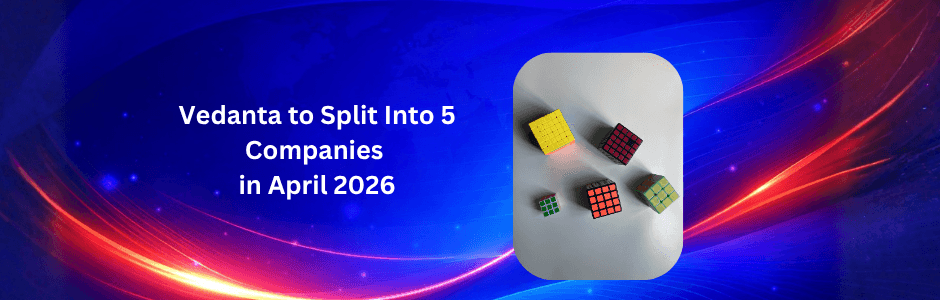
Vedanta borad of director's meeting held on Monday, April 20, as a part of its ongoing reorganisation, fixed May 1, 2026, as the record date for determining the shareholders eligible to receive consideration pursuant to the scheme of arrangement of its demerger into four entities (apart from already listed Vedanta).
What is the Vedanta demerger into 5 companies?
Under the approved demerger scheme, Vedanta Limited (currently an oil‑to‑metals conglomerate valued at about $27 billion) will be reorganised into five independent listed entities, each housing a core business segment. The National Company Law Tribunal (NCLT) approved the plan in December 2025, clearing the way for the split, which had first been proposed in 2023.
Under the scheme, eligible shareholders will receive one fully paid-up equity share of VAML, MEL, and VISL, with a face value of ₹1 each, for every one fully paid-up equity share of ₹1 each of the Vedanta they already own.
The five entities are expected to be:
- Vedanta Limited – base metals business (zinc, lead, silver, etc.).
- Vedanta Aluminium – aluminium operations.
- Talwandi Sabo Power – power business (coal‑based thermal power).
- Vedanta Steel and Iron – steel and iron businesses.
- Malco Energy – oil and gas activities.
Chairman Anil Agarwal has said the combined market capitalisation of the five entities could eventually exceed Vedanta’s current valuation of about $27 billion.
Why is Vedanta doing this?
The key objectives behind the five‑way split are:
- Debt reduction and balance‑sheet clarity: Separating cash‑flow‑generating businesses (like aluminium and power) from capital‑intensive and volatile segments can improve credit metrics and support deleveraging.
- Value unlocking: Investors can price each business more accurately, rather than valuing everything under a single, complex conglomerate umbrella.
- Strategic focus: Each entity can tailor its capital allocation, capex, and investor story to its sector (metals, aluminium, power, steel, oil & gas) instead of a one‑size‑fits‑all conglomerate model.
- Governance and transparency: Clear, sector‑specific boards and reporting should improve disclosures and investor confidence.
Chairman Anil Agarwal has publicly framed the demerger as a way to create “phenomenal shareholder value” and let each business run at its own pace.
NCDs Record Date :-
Additionally, the mining firm said that its non-convertible debentures (NCDs) (bearing ISINs INE205A07196, INE205A07220, INE205A08038 and INE205A08020) forming a part of Aluminium Undertaking will be transferred to VAML.
The board also fixed May 1, 2026, as the record date for determining the debenture holders for the said transfer pursuant to the scheme.
Impact on shareholders and structure
-
Existing shareholders of Vedanta Limited will receive shares in the new entities in a manner prescribed under the demerger scheme, typically via a stock‑for‑stock exchange.
- A private parent holding company controlled by Anil Agarwal’s group is expected to retain roughly 50% ownership in each of the five entities, giving the group continued influence while allowing public markets to price the rest.
- All five entities are planned to be listed on Indian stock exchanges, with the four demerged units (excluding the restructured Vedanta Limited) expected to list by mid‑May 2026, according to earlier timelines shared by Vedanta’s CFO.
Change of Name :-
The board of directors approved the change of the name of Talwandi Sabo Power Limited (TSPL) to Vedanta Power Limited, and of Malco Energy Limited (MEL) to Vedanta Oil and Gas Limited.
In terms of the Scheme and upon effectiveness thereof, the name of Talwandi Sabo Power Limited and Malco Energy Limited will change to ‘Vedanta Power Limited’ and ‘Vedanta Oil and Gas Limited’ respectively or such other name as may be approved by the Registrar of Companies (“ROC”),” the regulatory filing read.
Additionally, as part of the overall reorganisation, the company also approved the transfer of its shareholding in Bharat Aluminium Company Limited (BALCO) to VAML.
Vedanta has a total market capitalisation of ₹3.01 lakh crore as of April 20, 2026, according to data on the NSE.
Strengths
- Cleaner, focused business models for each segment.
- Potential for higher combined valuation vs single conglomerate structure.
- Easier debt management and targeted capital allocation per sector.
- Improves governance and sector‑specific investor communication.
- Unlocks value for minority shareholders via proper listing of each segment.
- Supported by strong shareholder and creditor approval (over 99% in key votes earlier in the plan).
Risks
- Execution complexity of a multi‑year demerger and listing calendar.
- Risk of valuation mismatch if markets underprice some segments.
- Cost of listing, compliance, and separate governance for five entities.
- Regulatory and tax uncertainty until the scheme is fully implemented.
- Short‑term volatility or confusion around share distribution among investors.

Popular Blogs