

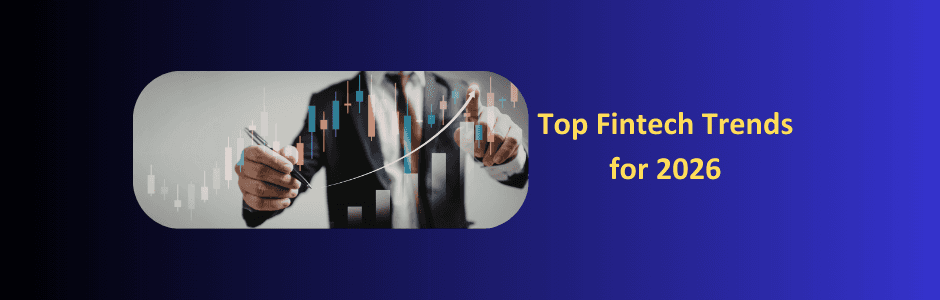
The Global Fintech industry has never moved faster. With AI crossing the threshold from experimental to operational, digital assets entering mainstream financial infrastructure, and regulators finally providing workable frameworks, H1 2026 marks a genuine inflection point for financial technology worldwide.
Global fintech investment reached $44.7 billion across 2,216 deals in H1 2025 alone, and the momentum has only intensified entering 2026. The fintech market surpassed $30 billion in addressable revenue in 2025, with 88% adoption among top-performing financial institutions. Meanwhile, AI adoption in finance functions has climbed to 59% of firms globally — up from just 37% in 2023.
From agentic AI rewriting the rules of banking operations, to embedded finance turning every app into a financial services hub, to CBDCs reshaping how money moves across borders — here are the 10 defining fintech trends for H1 2026 that every executive, investor, founder, and practitioner needs to understand.
Trend 1: Agentic AI — From Chatbots to Autonomous Financial Agents
Artificial intelligence has fully graduated from a back-office efficiency tool to a front-line driver of personalization, underwriting, fraud detection, and autonomous decision-making. In H1 2026, the defining shift is the rise of agentic AI — systems that don't just answer questions but independently execute complex, multi-step financial workflows.
Key Developments
- AI agents are functioning as virtual branch managers inside mobile apps, providing instant policy clarifications, processing loan applications, and escalating to human advisors seamlessly
- First-contact resolution in retail banking is exceeding 85% thanks to AI-powered voice banking and intelligent virtual assistants
- JPMorgan Chase's AI-driven Coach has already delivered 95% faster advisor research support and saved nearly $1.5 billion through fraud prevention and efficiency gains
- Developers using AI coding assistants are reporting productivity gains of up to 40% in coding speed — dramatically accelerating fintech innovation cycles
- More than 90% of international fintech businesses now extensively rely on AI and machine learning for core operations
- By late 2025, 43% of banks were deploying AI in internal risk, compliance, and fraud functions — with customer-facing AI deployment scaling rapidly into 2026
- AI in fintech is projected to reach a market size of $26.67 billion by 2026, growing at a CAGR of 23.17%
- Agentic AI paired with human intelligence (HI) is creating done-for-you financial advisory experiences — anticipating client needs before they arise
Use Cases
- Real-time fraud detection reducing investigation workload by 20% using ML behavioral pattern recognition
- Autonomous credit underwriting analyzing non-traditional data sources for faster, fairer lending decisions
- AI-powered compliance monitoring with live regulatory reporting and audit trail generation
- Hyper-personalized wealth management recommendations based on individual spending, saving, and investment behavior
Trend 2: Embedded Finance — Every App Becomes a Financial Services Hub
Embedded finance — the integration of lending, insurance, payments, and banking directly into non-financial platforms — is accelerating dramatically in H1 2026. The era of consumers needing to visit a bank or open a separate financial app is rapidly ending.
Key Developments
- The embedded finance market is projected to reach $7.2 trillion by 2030, surpassing the combined value of all fintech startups and the top 30 global banks and insurance companies
- Lyft enables drivers to access checking accounts and debit cards natively within the rideshare app — a model being replicated across gig, travel, and e-commerce platforms
- Open APIs and modular architecture are transforming fintech providers from standalone service companies into ecosystem enablers
- By 2026, every major non-financial platform — from payroll software to HR platforms to gaming apps — is emerging as a potential financial services distribution channel
- Embedded insurance, embedded lending, and embedded investment products are becoming standard features in enterprise SaaS platforms
- India's Credit Line on UPI (CLOU) is pioneering invisible credit — pre-approved credit lines accessible directly in a Scan & Pay flow, making physical cards redundant for daily retail transactions
Why This Matters
- Dramatically lowers customer acquisition costs for financial products by leveraging existing platform audiences
- Creates stickier ecosystems — users stay within a single super-app or platform for both financial and non-financial needs
- Opens entirely new revenue streams for non-financial companies without requiring a banking license
Trend 3: CBDCs — Central Bank Digital Currencies Move Mainstream
Central Bank Digital Currencies have crossed the threshold from research to reality. In H1 2026, 134 countries and currency unions — representing nearly all of global GDP — are exploring or actively developing a CBDC. Just four years ago, only 35 countries were exploring the concept.
Key Developments
- 66 countries are already in active pilot stage, deep in development, or have already launched their CBDC
- Programmable money — conditional payouts, automated compliance checks embedded directly into the currency — is gaining real traction
- CBDCs are enabling near-instant cross-border settlement, dramatically reducing costs and friction in international payments
- Banks and fintechs are racing to answer critical infrastructure questions: who distributes CBDCs, who builds the wallets, who manages digital identity?
- Retail CBDCs offer financial inclusion opportunities for unbanked populations — particularly in emerging markets across Africa, Southeast Asia, and South Asia
- Wholesale CBDC pilots between central banks are streamlining interbank settlement and reducing systemic risk
Fintech Opportunity
- Building CBDC wallet infrastructure, custody solutions, and digital identity layers
- Developing programmable payment applications that leverage CBDC conditional logic
- Creating cross-border payment corridors using interoperable CBDC rails
Trend 4: Real-World Asset (RWA) Tokenization — From Hype to $24 Billion Reality
Tokenizing real-world assets — bonds, real estate, private credit, commodities, and funds — has moved decisively from pilot projects to operational infrastructure in H1 2026.
Key Developments
- The total value of tokenized real-world assets reached approximately $24 billion by end of 2025
- The RWA tokenization market is projected to reach $16 trillion by 2030 — potentially the largest asset class migration in financial history
- Debt instruments — corporate bonds, government securities, short-term money market instruments — account for the largest share of early tokenization
- Major banks and global asset managers including BlackRock, JP Morgan, and HSBC are now actively tokenizing products on blockchain infrastructure
- The UAE, Dubai, and Abu Dhabi are aggressively positioning as global RWA tokenization hubs, attracting talent, capital, and regulatory frameworks
- ASPAC asset management firms are modernizing front-, middle-, and back-office operations through fund tokenization and blockchain-based settlement
- Custody, compliance, and settlement infrastructure supporting tokenized assets is maturing rapidly — reducing earlier concerns around trust and reconciliation
Benefits Driving Adoption
- 24/7 settlement without traditional T+2 delays, dramatically improving capital efficiency
- Fractional ownership democratizing access to previously illiquid assets like real estate and private equity
- Automated compliance and distribution through smart contracts embedded in tokens
Trend 5: Open Banking Evolving into Open Finance
Open banking has scaled to 87% adoption among global banks — either directly or through technology partners. In H1 2026, the next evolution is underway: open banking is expanding into open finance, encompassing insurance, pensions, investments, and mortgages in a unified data-sharing ecosystem.
Key Developments
- API-driven models like Yavrio connect to the five largest US banks and enable embedded real-time payments — showcasing open banking expanding into corporate finance
- Standardized data-sharing frameworks are improving interoperability between banks, fintechs, and third-party providers at scale
- Open finance mandates are giving consumers unprecedented control over their entire financial data footprint — not just bank accounts
- Real-time personalization powered by open banking data is enabling fintechs to offer product recommendations with previously impossible accuracy
- Risk modeling is improving dramatically as lenders access richer, real-time financial behavior data beyond traditional credit scores
- The UK, EU (PSD3), Australia (CDR), and India (OCEN/Account Aggregator) are leading with regulatory frameworks mandating open finance
Trend 6: Stablecoin & Crypto Regulation — Clarity Replaces Uncertainty
After years of regulatory ambiguity, H1 2026 marks the beginning of a clearer, rules-based era for digital assets — particularly stablecoins. The result is a surge of institutional confidence and mainstream adoption.
Key Developments
- The GENIUS Act (July 2025, USA) provides a unified legal framework for stablecoins, improving consumer protection and supporting broader adoption across payment processors and fintech apps
- The EU's Markets in Crypto-Assets Regulation (MiCA) provides a parallel comprehensive stablecoin and crypto regulatory framework across all 27 EU member states
- Stablecoins and digital assets are attracting strong investor interest globally, driven by improving regulatory clarity and expanding real-world use cases
- Capital markets are expanding tokenized stablecoin use into debt instruments, project finance, and cross-border trade settlement
- Stricter governance, disclosure, and reserve management standards are raising the bar — driving consolidation among weaker stablecoin issuers
- Fintech companies can now build stablecoin-enabled payment products with significantly lower legal risk than in previous years
Trend 7: RegTech — Compliance Becomes Competitive Infrastructure
Regulators are no longer waiting for fintechs to mature before intervening. In H1 2026, compliance is moving from a back-office function to core product infrastructure — and RegTech is the technology making that transition possible at scale.
Key Developments
- Next-gen compliance programs automate policy monitoring, risk flagging, audit trail generation, and regulatory reporting in real time
- Pre-licensing inquiries, partnership reviews, and scrutiny of embedded finance models are becoming routine — making early compliance investment a strategic advantage
- KYC, AML, and transaction monitoring automation is reducing compliance costs by 30-50% for mid-sized fintechs while improving accuracy
- AI-powered RegTech tools now span sanctions screening, ESG reporting, data residency management, and GDPR/DPDP compliance
- Regulatory sandboxes in Singapore, UK, UAE, and India are accelerating RegTech testing and approval cycles
- Third-party vendor risk management is becoming critical — 41.8% of fintech data breaches originate with third-party partners
Trend 8: Neobanks & Challenger Banks — Maturing Into Profitability
The neobank growth story in H1 2026 is no longer about customer acquisition at any cost — it's about sustainable profitability, product expansion, and competing directly with traditional banks on their home turf.
Key Developments
- Global neobank customer base is projected to exceed 360 million in 2026 — up from 145 million in 2021, representing 148% growth in five years
- Leading neobanks including Nubank, Revolut, and Chime are expanding from payments into lending, wealth management, insurance, and business banking
- Cloud-native core banking systems are enabling neobanks to launch new products in days rather than the months required by legacy infrastructure
- Multilingual AI-powered interfaces are helping neobanks penetrate emerging markets in Latin America, Africa, Southeast Asia, and South Asia
- Traditional banks are responding through acquisition, partnership, and internal digital banking initiatives — intensifying competition
- Emotion-aware banking — AI systems that detect user frustration, anxiety, or confusion and adapt their UX response — is emerging as a neobank differentiator
Trend 9: Big Data, WealthTech & Hyper-Personalization
Data is the new currency of fintech differentiation. In H1 2026, the ability to collect, process, and act on real-time financial behavioral data is separating market leaders from the rest of the pack.
Key Developments
- Big data analytics enables fintech companies to segment customers by age, location, income, spending patterns, and behavioral signals — delivering truly individualized financial products
- WealthTech platforms are democratizing access to investment advisory services previously available only to high-net-worth individuals
- AI-assisted financial planning tools are providing real-time portfolio rebalancing, tax optimization, and goal-tracking without human advisor intervention
- Predictive analytics in credit risk is enabling more accurate default prediction — improving approval rates for underserved borrowers while reducing NPL ratios
- Real-time spending analytics embedded in banking apps are becoming a customer retention tool, not just a feature
- ESG data integration in investment platforms is responding to growing consumer demand for sustainable and socially responsible portfolios
- Generative Engine Optimization (GEO) is reshaping how fintech brands establish market presence — shifting from campaign-driven marketing to intelligence-driven thought leadership
Trend 10: Cybersecurity, Post-Quantum Cryptography & Zero Trust
As fintech ecosystems expand across APIs, third-party vendors, cloud infrastructure, and DeFi integrations, the attack surface is growing. H1 2026 is seeing the fintech industry move decisively toward zero-trust security architectures and prepare for the post-quantum era.
Key Developments
- 41.8% of fintech data breaches originate with third-party vendors — making supply chain security and vendor risk management a board-level priority
- Post-quantum cryptography (PQC) is moving from research labs into actual fintech infrastructure — with regulators in the US, UK, and EU beginning to mandate quantum-safe encryption timelines
- Zero-trust security models — where no user, device, or network is trusted by default — are replacing perimeter-based security across financial institutions
- Behavioral biometrics (keystroke dynamics, mouse movement patterns, touch pressure) are supplementing traditional MFA for continuous authentication
- AI-driven security systems are detecting anomalies in real time and triggering automated incident response — reducing breach detection time from months to minutes
- Cloud-native security architectures are enabling fintechs to maintain compliance across multi-region jurisdictions from a single security operations center
📊 Key Market Data: H1 2026 Fintech at a Glance
- Global fintech investment: $44.7B across 2,216 deals in H1 2025 — momentum accelerating into H1 2026
- AI in fintech market size: $26.67 billion projected by 2026, CAGR 23.17%
- Embedded finance addressable market: $7.2 trillion projected by 2030
- Tokenized RWA market: $24 billion (2025) → $16 trillion projected by 2030
- CBDC exploration: 134 countries and currency unions — 66 in active development or pilot stage
- Neobank users: 360 million projected globally by end of 2026
- Open banking adoption: 87% of global banks have implemented capabilities
- Fintech AI adoption (CFO survey): 59% of finance functions using AI in 2025, up from 37% in 2023
- EMEA fintech funding: $13.8B across 617 deals in H2 2025
- Global fintech startups: 42,500+ in the US alone

Popular Blogs