

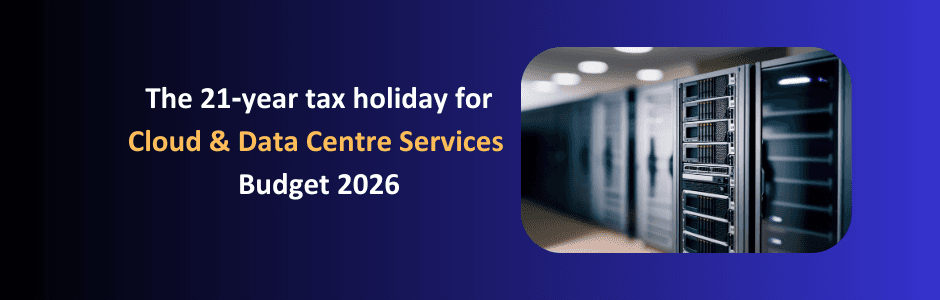
Budget 2026 has introduced a 21‑year tax holiday and a ₹2,000 crore safe harbour for data centres, especially those powering AI and cloud services, positioning India as a global hub for digital infrastructure.
The 21‑year tax holiday for cloud and data centre services : what it means
- Foreign and domestic companies providing cloud and data centre services will get a 21‑year tax holiday (till 2047) if they set up data centres in India, with a 15% safe harbour rate for Indian providers (threshold ₹2,000 crore).
- IT Minister Ashwini Vaishnaw called it a “long‑term policy framework” to attract massive investments from global giants like Google, Microsoft and Amazon.
- The move targets AI and cloud infrastructure, recognising data centres as the “critical infrastructure layer” for digital growth.
Why data centres matter now
- India’s data centre capacity hit 1.5 GW across seven major cities by end‑2025 and is projected to cross 1.7 GW by end‑2026, driven by exploding demand from 1,000 million active internet users (growing 8% YoY).
- India generates 20% of global data but stores/processes 95% of it abroad, raising national security concerns and limiting local AI/cloud development.
- Global giants like Google, Microsoft and Amazon (controlling 63% of cloud market) have committed over $30 billion for India’s cloud/AI infra over 14 years, but tax certainty was a key hurdle.
Challenges data centres face
- Data centres are capital, power, water and land‑intensive:
- Power: Need massive electricity (expected to hit 2% of national supply).
- Water: Existing centres used 150 billion litres in 2025, projected to double to 358 billion by 2030.
- Land: Large tracts needed for hyperscale facilities.
- India’s challenges like heatwaves, droughts, power shortages and land acquisition make scaling tough, but lower costs than China/US/Japan give a competitive edge.
Advantages of the data centre tax holiday
- 21‑year certainty enables massive capex commitments from global hyperscalers for AI/cloud buildout.
- Attracts $10s of billions from Google, Microsoft, Amazon to build local storage/processing, reducing 95% foreign data dependency.
- Creates jobs and ecosystem in power, cooling, construction, fibre optics and tech services.
- Lowers cloud/AI compute costs for Indian startups/SMEs via local hyperscale capacity.
- Positions India as a global AI/cloud hub, leveraging cheap land/power and 20% of world data generation.
Risks and challenges
- Power demand could spike to 2% of national supply, straining grids and clashing with decarbonisation goals (renewables still limited).
- Water usage (150–358 billion litres) is massive in a drought‑prone country where millions lack clean drinking water.
- Land acquisition hurdles and NIMBY resistance in urban areas for hyperscale facilities.
- Tax holiday may not guarantee investments if power/water/land issues persist or global cloud demand shifts.
- Data sovereignty risks if foreign firms dominate; need for local players and regulations.
Open A Free Demat Account Today
Get StartedHow to Calculate Intraday Brokerage Charges? Formula & Examples

10 Sep 2026
RSU vs ESOP: Key Differences, Taxation, Vesting and What Employees Should Know
27 Aug 2026
ESPP vs ESOP: Key Differences, Taxation, Vesting and How They Work
27 Aug 2026
FAST-DS Explained: Foreign Asset Disclosure Scheme Opens
17 Aug 2026
ITR Filing Guide for Content Creators 2026: Instagram, YouTube & More
11 Aug 2026
ESOP Income in ITR AY 2026-27
30 Jul 2026
Tax Implications of Loan Against Mutual Funds
29 Jul 2026
SIF Taxation in India: LTCG, STCG & TDS Rules
26 Jul 2026
What Happens If You Don't File ITR? Penalties & Consequences 2026
22 Jul 2026
Capital Gains Tax on Mutual Funds in India
21 Jul 2026
Popular Blogs