

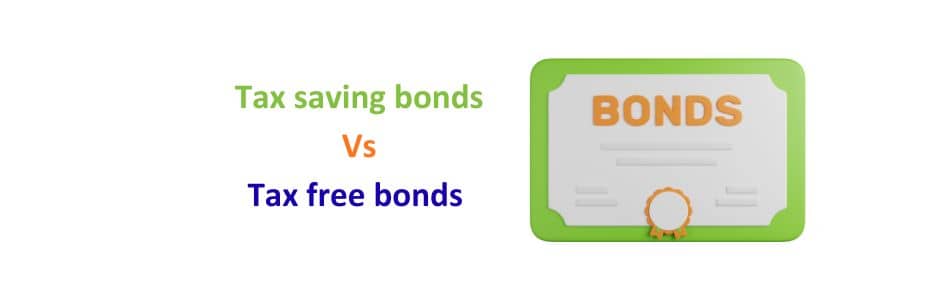
Tax saving bonds and Tax free bonds both offer tax advantages, but in very different ways: tax saving bonds help you reduce or defer a specific tax liability (usually on capital gains or under a deduction section), while tax free bonds give you regular interest that is fully exempt from income tax.
What are tax saving bonds?
Tax saving bonds in India typically refer to capital gains bonds under Section 54EC and, in some contexts, specified bonds that offer deductions (like older Section 80CCF structures).
- Section 54EC capital gains bonds (NHAI, REC, PFC, IRFC etc.) allow you to reinvest long‑term capital gains from sale of land/building into notified bonds within 6 months to claim exemption on that capital gain, up to ₹50 lakh.
- These bonds have a 5‑year lock‑in, are non‑transferable, and carry a fixed coupon (often around 5–6% p.a.), but the interest is fully taxable at your slab rate.
- The tax benefit is on the principal (capital gain amount) through exemption under Section 54EC, not on the interest.
In short, they are mainly used as a one‑time tax shield when you have long‑term capital gains, especially from property.
What are tax free bonds?
Tax free bonds are typically issued by government‑backed entities (like NHAI, PFC, IRFC, HUDCO etc.) where the interest income is completely exempt from income tax under Section 10(15).
- Investors pay no tax on the interest if the bonds are held, and there is generally no TDS on such interest.
- The principal invested does not qualify for Section 80C or other deductions; the benefit lies purely in the tax‑free nature of the interest.
- These bonds usually come with long tenors (10–20 years), are listed, and can be bought or sold in the secondary market, though liquidity varies.
- Capital gains on selling these bonds before maturity can still be taxable depending on the holding period.
They suit investors in higher tax brackets who want stable, tax‑efficient interest income rather than a one‑time tax exemption.
Key differences: tax saving vs tax free bonds :-
|
Parameter |
Tax saving bonds (e.g., 54EC) |
Tax free bonds |
|
Primary tax benefit |
Exemption on long‑term capital gains (usually from land/building) when gains are reinvested in specified bonds within 6 months. |
Interest earned is fully exempt from income tax under Section 10(15). |
|
Tax on interest |
Fully taxable at your slab; no special concession. |
Interest is tax‑free; generally no TDS. |
|
Lock‑in / tenor |
Mandatory 5‑year lock‑in, non‑transferable. |
Typically long tenor (10–20 years); usually tradable on exchanges. |
|
When to use |
When you have significant long‑term capital gains and want to avoid/ reduce capital gains tax. |
When you want steady, tax‑efficient income, especially in higher tax brackets. |
|
Section of IT Act |
Section 54EC (capital gains exemption). |
Section 10(15) (tax‑exempt interest on specified bonds). |
How JM Financial Services can help :-
A full‑service intermediary like JM Financial Services can help you:
- Assess whether 54EC tax saving bonds or tax free bonds better fit your situation (e.g., selling a property vs. building a tax‑efficient income ladder).
- Execute purchases through their bond desk or distribution partners, evaluate issuer credit quality, and position these instruments within a broader asset allocation, alongside debt mutual funds, corporate bonds, and other fixed‑income products.
- Optimise tax planning by combining bonds, mutual funds, and other instruments as per your risk profile and time horizon.
Frequently Asked Questions

Popular Blogs