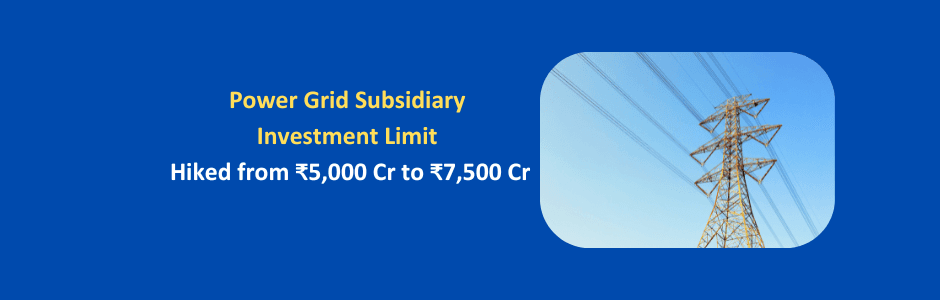
Power Grid Subsidiary Investment Limit Hiked from ₹5,000 Cr to ₹7,500 Cr


Power Grid Corporation of India (POWERGRID) gets a major boost as the Cabinet raises its per‑subsidiary equity investment limit from ₹5,000 crore to ₹7,500 crore, unlocking faster execution of massive transmission projects to support India's 500 GW non‑fossil energy target by 2030.+2
The Big Decision – What Changed?
Cabinet Committee on Economic Affairs (CCEA), chaired by PM Narendra Modi, approved the enhanced delegation under Maharatna guidelines on February 24, 2026:
|
Parameter |
Before |
After |
|
Per‑Subsidiary Limit |
₹5,000 Cr |
₹7,500 Cr |
|
Overall Cap |
15% of net worth |
Unchanged |
Why it matters: This allows POWERGRID to invest more aggressively in subsidiaries/SPVs without repeated government approvals, speeding up bids for large transmission projects.
Why Now? India's 500 GW Green Energy Push
India's 500 GW non‑fossil target by 2030 needs massive transmission upgrades:
- Renewable sites far from load centres: Ladakh solar, Gujarat wind, Rajasthan hybrids → need UHVAC/HVDC corridors for bulk evacuation.
- Transmission capex: ₹9.16 lakh crore planned (2023–2032) for central/state systems to handle 458 GW peak demand by 2032.
- POWERGRID's role: Transmits ~50% of India's power; needs to scale for geographically dispersed RE integration.
Old limit bottleneck: ₹5,000 Cr cap restricted SPV equity for ₹20,000+ Cr projects under TBCB (Tariff Based Competitive Bidding).
What This Unlocks for POWERGRID
Project Acceleration
- Bigger TBCB bids: Can now back larger, complex projects like UHVAC (Ultra High Voltage AC) and HVDC (High Voltage DC) lines.
- RE corridors: Faster green energy evacuation from remote solar/wind parks to cities/industry hubs.
- Competition boost: Deeper participation → better price discovery → lower tariffs for consumers.
Financial Impact
|
Metric |
Impact |
|
Capex flexibility |
Larger SPVs → more projects won |
|
ROE stability |
Regulated returns (14–15.5%) on equity invested |
|
Debt capacity |
Leverage maintained at ~6x |
|
Order book |
₹3 lakh Cr capex planned till 2032 |
Market Reaction & Stock Outlook
Share price: POWERGRID gained ~3–5% post‑announcement as investors priced in faster order wins and execution.
Key positives:
- Monopoly franchise: Largest transmission utility (~50% ISTS share).
- Regulated returns: Stable 14–15.5% RoE on equity.
- Green tailwinds: Essential for 500 GW target.
Watchouts:
- Interest rate sensitivity: Debt‑heavy balance sheet.
- Execution delays: Land acquisition, approvals.
- TBCB competition: Private players gaining share.
Strengths of Power Grid Investment Hike
- Unlocks faster execution of ₹3 lakh Cr transmission capex pipeline.
- Enables larger UHVAC/HVDC bids critical for 500 GW RE evacuation.
- Removes govt approval bottlenecks for subsidiary investments.
- Enhances TBCB competitiveness vs private transmission players.
- Stable regulated RoE (14–15.5%) on growing equity deployment.
- Strategic monopoly in ISTS transmission (~50% market share).
Risks of Power Grid Expansion
- High debt leverage (~6x) sensitive to interest rate rises.
- Land acquisition/approval delays plague large transmission projects.
- Intensifying TBCB competition from private players.
- Policy/regulatory changes in transmission tariffs.
- Execution risk scaling UHVAC/HVDC technology at scale.

Popular Blogs