

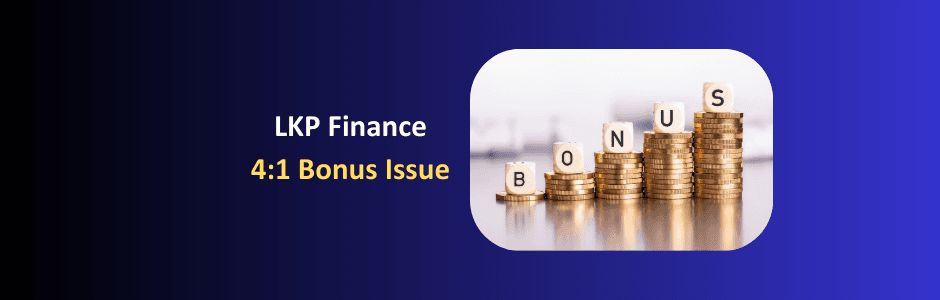
LKP Finance has approved a 4:1 bonus issue, granting shareholders 4 new fully-paid equity shares (FV ₹10) for every 1 existing share, funded from its securities premium after a ~400% one-year share price rally.
LKP Finance 4:1 bonus issue – Key details
-
Company: LKP Finance Limited – listed NBFC engaged in financing, capital market and related financial services.
- Bonus ratio: 4:1 – shareholders get 4 additional fully paid-up shares for every 1 share held as on the record date (to be announced).
- Face value: All shares (existing and bonus) carry ₹10 face value.
- Funding source: Bonus shares will be issued by capitalising the Securities Premium Account; no cash outflow.
- Authorised capital increase:
- Old: ₹30 crore.
- New: ₹110 crore, to accommodate 4× equity expansion and future needs.
- Paid-up capital impact:
- Before bonus: ₹15.36 crore (1,53,61,650 shares).
- After bonus: ₹76.80 crore (7,68,08,250 shares).
- Timeline: Board approval on 19 January 2026; bonus shares expected to be credited / dispatched by 19 March 2026, subject to shareholder and regulatory approvals.
- Share price context: Stock delivered ~400–408% return in 1 year, trading around ₹1,096–1,149 near the announcement.
What the 4:1 bonus means for shareholders
-
If you own 1 share, post-bonus you will own 5 shares (1 old + 4 new).
- If you own 100 shares, post-bonus you will own 500 shares.
- Total investment value does not change on ex‑bonus day in theory; the share price typically adjusts downward to reflect the 5× increase in number of shares.
- Example: If LKP Finance trades at ₹1,100 pre‑bonus, a pure math adjustment implies a post‑bonus reference of around ₹220 (₹1,100 ÷ 5), while your total value (shares × price) stays broadly similar, ignoring market moves.
The company explicitly states the bonus aims to “reward shareholders and enhance stock liquidity”, a typical rationale when reserves are strong and the share price has run up sharply.
Strengths / positives of LKP Finance 4:1 bonus
-
Shareholder reward after multibagger run: 4:1 bonus follows a ~400–408% price rally in 12 months, signalling management’s confidence and willingness to share perceived success with investors.
- Improved liquidity and affordability: Increasing shares from 1.53 crore to 7.68 crore and lowering the per‑share price post‑adjustment can attract more retail participation and tighter bid‑ask spreads.
- Capital structure strength: Funding the bonus purely from securities premium and simultaneously increasing authorised capital to ₹110 crore indicates robust reserves and room for future expansion.
- No dilution of percentage ownership: Each shareholder’s percentage stake remains the same; only the number of shares and paid‑up capital change.
- Signal of financial health: Bonus issues are typically associated with companies that have strong balance sheets and accumulated reserves, often viewed positively by the market.
Risks / things to be cautious about
-
No change in intrinsic value: A bonus issue does not improve fundamentals by itself; EPS and book value per share get mathematically diluted as shares increase 5×.
- Post‑bonus volatility: After ex‑bonus, re‑pricing and profit‑booking can cause sharp short‑term price swings; multibagger moves already raise the risk of corrections.
- Perception vs reality: Retail investors may misread bonus as “free money”; in reality, market cap remains broadly the same, and future returns depend on earnings growth, asset quality and business performance.
- Higher equity base: Paid‑up capital jumps 5×; to sustain or grow EPS, the company must generate proportionately higher profits, or valuation multiples must expand.
- Regulatory & approval risk: Bonus issue and capital increase are subject to shareholder approval and regulatory clearances; delays could shift the expected credit timeline.

Popular Blogs