

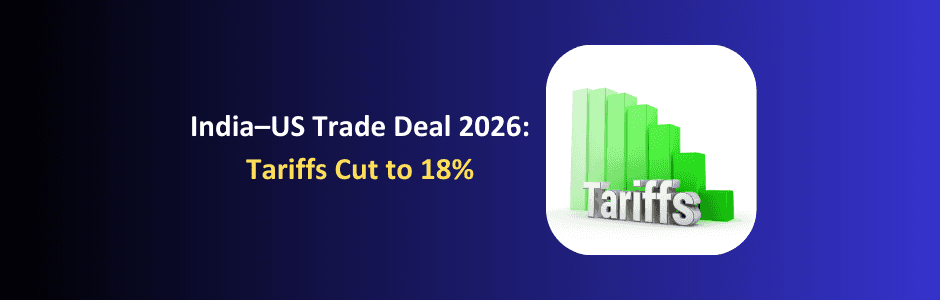
India and the US have just struck a new trade deal that rolls back part of Washington’s tariff offensive and lowers average US duties on Indian goods to 18%, in exchange for New Delhi opening up further and re‑aligning some of its energy and trade policies.
India–US trade deal on tariffs: what changed?
-
Until recently, many Indian exports to the US attracted a punitive stack of tariffs that could go up to about 50% on average: a 10% baseline duty, another 15% “reciprocal” layer, plus an extra 25% penalty linked to India’s Russian oil purchases and other geopolitical issues.
On 2 February 2026, President Donald Trump announced that the US and India had agreed to a trade deal, immediately reducing the reciprocal tariff from 25% to 18% and scrapping the additional 25% punitive duty, bringing the overall average tariff on Indian goods down to 18%.
In return, India has committed to lowering tariffs and non‑tariff barriers on US exports “towards zero” over time, halting purchases of Russian oil, and ramping up imports of US energy, technology, agriculture and coal products.
What the tariff cuts mean, sector by sector
Indian exports to the US
-
-
Labour‑intensive sectors like textiles, garments, leather, gems & jewellery, engineering goods and some pharma products had been hit by higher duties and uncertainty since 2025; the rollback to 18% improves price competitiveness and visibility for exporters.
- Removal of the extra 25% penalty especially eases pressure on higher‑value items such as petrochemicals, metals, specialised machinery and auto components.
-
US exports to India
-
India’s side of the bargain includes moving gradually toward zero tariffs and fewer non‑tariff barriers on US goods, meaning more open access in oil & gas, coal, agri products (like pulses, edible oil, grains), high‑tech equipment and possibly defence‑related technology.
- This could lower input costs for Indian industry but also intensify competition for some domestic producers in agriculture and energy‑linked sectors.
Energy & geopolitics
-
A key trade‑off is India’s agreement to stop or sharply curtail Russian oil purchases in favour of US and “friendly” supplies, linking trade tariffs directly with energy and foreign policy choices.
Strengths / opportunities of the new India–US tariff deal
- Lowers average US tariffs from about 50% to 18% on Indian goods, restoring much‑needed pricing power and certainty for exporters after months of brinkmanship.
- Reduces the risk of a prolonged trade war that could have derailed a strategic partnership and hurt India’s $80–90 billion export flow to the US.
- Puts India back on a clearer path to diversify exports beyond EU and Middle East markets, just as the India–EU FTA is being concluded.
- Signals that both sides can still strike deals despite tensions over Russia, BRICS and digital taxes, which is positive for investors looking at long‑term India–US supply‑chain integration.
- More predictable tariff regime can support firm‑level capex decisions in sectors such as apparel, auto components, engineering and IT‑linked manufacturing aimed at the US market.
Risks / trade‑offs in the India–US tariff deal
- India’s commitments to move its own tariffs and non‑tariff barriers closer to zero for US goods could pressure some domestic producers, especially in agriculture, energy‑linked commodities and sensitive manufactured products.
- Shifting away from Russian oil reduces India’s bargaining leverage on crude prices and concentrates dependence on fewer suppliers, potentially raising long‑term import costs and vulnerability to US policy.
- The average 18% US tariff is still higher than pre‑2025 norms for many lines, and the deal could be revisited if geopolitical tensions flare up, so policy risk remains elevated.
- The agreement is heavily presidential‑personality driven; changes in US politics or future administrations could again weaponise tariff policy.
- Domestic critics may see the concessions as compromising strategic autonomy and giving up too much on market access and energy choices for limited tariff relief.

Popular Blogs