

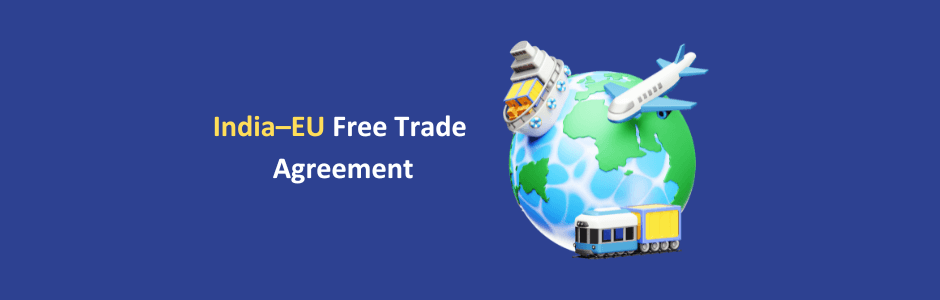
India and the EU have just concluded a landmark free trade agreement (FTA) that will create one of the world’s largest trade zones, covering roughly a quarter of global GDP and aiming to sharply reduce tariffs on most goods and many services over the next decade.
India–EU Free Trade Agreement: Overview
-
After nearly 20 years of on‑off negotiations, India and the European Union have agreed on what leaders are calling the “mother of all deals,” a comprehensive FTA covering goods, services and trade rules.
- The pact is expected to double EU goods exports to India by around 2032, while opening up a 27‑nation, high‑income market more fully to Indian exporters.
- Formal signing will follow a legal “scrubbing” and ratification process, with implementation targeted within about a year, subject to approval by the European Parliament and Indian processes.
Key features of the India–EU FTA
-
Tariffs will be eliminated or substantially reduced on around 96–97% of EU exports to India by value, and over 90% of bilateral trade in goods overall.
- For India, priority export sectors such as textiles, garments, leather, gems and jewellery gain improved access to the EU, where these products already face moderate but meaningful tariffs.
- Sensitive sectors (like agriculture and some dairy lines) are only partially covered or excluded, reflecting India’s domestic protection concerns; separate talks continue on investment protection and geographical indications.
Sector‑wise impact snapshot
-
Automobiles and auto components
- India will gradually cut tariffs on imported European cars from extremely high levels (around 110%) to about 10% over 5–10 years; duties on many auto components will be phased out.
- This benefits European OEMs (Volkswagen, BMW, Mercedes‑Benz, Renault) and can also push Indian auto firms to move up the value chain and focus on exports.
- Machinery, chemicals, pharma, aviation
- Tariffs on a wide range of EU machinery, electrical equipment, chemicals and pharmaceuticals will be removed or sharply reduced, with aircraft and spacecraft facing near‑zero duties on most lines.
- Alcoholic beverages and processed foods
- Duties on EU wine and spirits will fall substantially (for example, wine from 150% towards 20–30% over time), while tariffs on many fruit juices and processed foods will be eliminated.
- Services and investment
- EU companies gain better access in financial, maritime and other services, while India pushes for mobility of professionals and recognition of qualifications; some elements are being handled in parallel tracks.
Strengths / opportunities of the India–EU FTA
-
Creates a huge India–EU free trade zone touching roughly 25% of global GDP and around 2 billion people, deepening integration between a fast‑growing emerging market and a high‑income bloc.
- Expected to double EU exports to India by 2032 and significantly boost Indian exports in labour‑intensive sectors like textiles, leather and gems and jewellery.
- Helps India diversify export markets away from the US and China, and helps the EU reduce dependence on China by anchoring supply chains in India.
- Brings deeper tariff cuts than any previous Indian trade deal for sensitive sectors like autos, wines and some agricultural products, potentially making India a more attractive production hub.
- Offers Indian consumers more choice and, over time, likely better prices in imported cars, machinery, premium food and beverages, and technology‑rich goods.
- Encourages technology transfer, standards alignment and investment in green, digital and advanced manufacturing as part of a strategic, long‑term India–EU partnership.
Risks / challenges of the India–EU FTA
-
Concerns in Indian automobile, dairy, wine & spirits and some agricultural segments about import competition and pressure on domestic producers.
- Implementation depends on ratification by the European Parliament and domestic politics in EU member states; opposition like that seen on the EU–Mercosur deal could delay or dilute outcomes.
- The EU’s Carbon Border Adjustment Mechanism (CBAM) may erode some of India’s tariff gains, especially for steel, cement and other carbon‑intensive exports.
- Non‑tariff barriers – standards, certifications, regulatory complexity – remain significant and can limit real market access despite headline tariff cuts.
- Pressure on India to open up quickly (95%+ tariff lines) versus its comfort zone nearer 90% may create friction and calls for safeguards if import surges hurt local industry.
- Adjusting to tougher EU norms on labour, environment and data could raise compliance costs for smaller Indian exporters in the near term.
Frequently Asked Questions

Popular Blogs