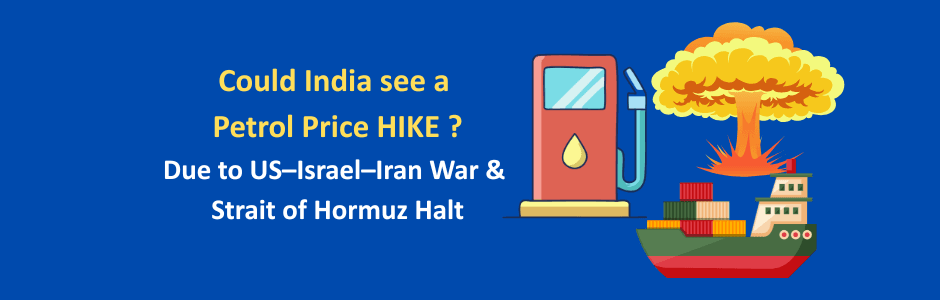
Could India see a Petrol Price HIKE ? Due to US–Israel–Iran War & Strait of Hormuz Halt


India is looking at clear upside pressure on petrol and diesel prices as the US–Israel–Iran war halts traffic through the Strait of Hormuz, driving global crude sharply higher and raising India’s import bill, inflation, and rupee pressure.
Why the Strait of Hormuz matters for India’s Fuel
-
Around 50% of India’s crude oil and 60% of its LNG move through the Strait of Hormuz, making India one of the most exposed major economies to any blockade or shipping halt.
- Even short disruptions trigger higher freight, insurance, and rerouting costs, feeding directly into landed crude prices for Indian refiners.
- India imports close to 89% of its crude needs, so any spike in Brent immediately worsens the current account deficit and rupee, amplifying domestic fuel price pressures.
How global crude moves hit Indian petrol & diesel
1. Crude spike and import bill
- Brent has already jumped from the low $70s to near/above $80 per barrel, with scenarios of $90–$130+ being discussed if the blockade persists.
- For India, every $1/bbl rise in oil adds roughly $2 billion to the annual import bill, forcing higher pump prices unless the government or OMCs absorb the shock.
2. Freight, insurance, and rerouting
- With Hormuz traffic halted or heavily restricted, tankers are either rerouted around the Cape of Good Hope or face extreme war‑risk insurance premiums, adding several dollars per barrel to effective costs.
- Even if some barrels are sourced from Russia, US, Africa, or Latin America, longer voyages and tight shipping capacity keep landed costs elevated.
3. Rupee and inflation feedback loop
- Higher oil imports mean more demand for dollars, putting downward pressure on INR, which further inflates rupee‑denominated crude costs.
- Dearer petrol and diesel pass through into transport, food, and core inflation, potentially forcing the RBI to delay or reverse rate cuts, hurting growth.
India’s shock absorbers – what can soften the blow?
- Strategic reserves & alternative suppliers
- India holds about 9–10 days of crude demand in strategic reserves, and together with oil company inventories, has roughly 60–70 days of buffer to smooth short‑term disruptions.
- The government can rapidly ramp up Russian “Urals” purchases, plus imports from US, Nigeria, Angola, Brazil, which bypass Hormuz, though at higher freight and possible insurance constraints.
- Pipelines outside Hormuz
- India is negotiating extra volumes via Saudi’s East‑West pipeline and Abu Dhabi’s crude pipeline that terminate at ports outside the Persian Gulf, but these lines have limited spare capacity and are in demand from China and Japan as well.
- Policy tools
- The Centre can choose to keep retail prices unchanged for some time, letting IOC/BPCL/HPCL take margin hits (as seen in past spikes), or use targeted subsidies if inflation turns politically sensitive.
- It can also tweak excise duties on petrol/diesel to partly absorb price shocks, though that hurts fiscal math.
Likely Impact path for Petrol Prices in India
While the exact rupee value depends on duration and severity of the Hormuz halt, the broad pattern would be:
- Short term (weeks)
- Brent spikes, OMCs may hold pump prices steady initially, absorbing hits in marketing margins.
- If spike sustains, expect gradual hikes in petrol and diesel, especially in non‑election periods.
- Medium term (months)
- If crude stabilises at a higher but not extreme level (say $90–$100), govt may mix small price hikes with excise tweaks to keep inflation manageable.
- Airlines, logistics, and discretionary sectors face higher fuel and ATF costs, pushing up fares and freight.
- Worst‑case (prolonged blockade)
- If prices run towards $130–$150+, India could see sharp fuel hikes, wider fiscal support (subsidies) and RBI hawkishness, risking slower growth and stagflation‑like conditions.
Strengths in India’s fuel security
- Diversified supplier base: Russia, US, Africa reduce over‑reliance on Gulf barrels.
- Strategic reserves plus OMC stocks provide ~2 months of effective buffer.
- Policy tools: excise duty, subsidies, and OMC margin flexibility to smooth pump prices.
- Growing renewables and EV adoption slowly reduce oil intensity over time.
Risks to Indian petrol prices from US–Israel–Iran war
-
Prolonged Hormuz halt pushing oil towards $130–$150+ per barrel.
- Sustained INR weakness amplifying imported inflation on fuel.
- Margin erosion for OMCs if retail prices are politically frozen.
- Higher transport and input costs feeding into broad‑based CPI inflation.
- Risk of fiscal slippage if subsidies or duty cuts are used heavily.

Popular Blogs