

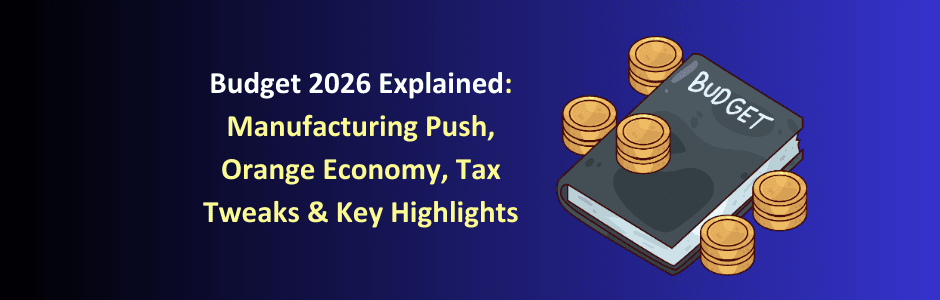
Budget 2026, presented by Finance Minister Nirmala Sitharaman from Kartavya Bhawan, prioritises manufacturing revival, strategic sectors and fiscal discipline over headline schemes, with a clear focus on scaling production, skilling and infrastructure to drive Viksit Bharat by 2047.
Manufacturing as the core theme
Budget 2026 positions manufacturing as the backbone of growth, drawing lessons from global powerhouses like the US and China that used factories to absorb labour and boost exports. Key interventions target seven strategic sectors:
- Biopharma SHAKTI: ₹10,000 crore over five years to build capacity for biologics/biosimilars, 1,000+ clinical trial sites and strengthen CDSCO approvals.
- Semiconductors (ISM 2.0): Expands beyond fabrication to equipment, materials and IP creation, plus industry-led training.
- Electronics: Scales Components Manufacturing Scheme from ₹22,919 crore to ₹40,000 crore after doubling investment commitments.
- Rare Earth Permanent Magnets: Operationalises scheme and creates Rare Earth Corridors in mineral-rich states like Odisha and Kerala.
- Chemicals: Supports three dedicated Chemical Parks to cut import dependence.
- SME Growth Fund: ₹10,000 crore equity support for high-potential MSMEs, plus ₹2,000 crore top-up for Self-Reliant India Fund.
Agriculture and high-value crops
Agriculture employs half the workforce despite shrinking GDP share (from 35% in 1991 to 18% now), so Budget emphasises productivity without endless MSP/subsidies:
- Coconut Promotion Scheme: Replaces ageing trees with high-yield varieties for 30 million livelihoods (India is top producer but low productivity).
- Regional high-value crops: Sandalwood/cashew revival in coastal areas, agar in North East, cocoa self-reliance for chocolate demand.
- Bharat-VISTAAR: Multilingual AI tool integrating AgriStack and ICAR data for customised farmer advice in local languages.
Orange Economy and creative industries
A fresh focus on the "orange economy" (music, films, art, design, performances) recognises its multiplier effect:
- AVGC Labs: Indian Institute of Creative Technologies (IICT) Mumbai to set up labs in 15,000 schools and 500 colleges for animation, VFX, gaming skills.
- Targets 2 million jobs by 2030 in visual design, AR/VR, digital content for virtual concerts and immersive experiences.
- Live events boost hotels, transport, retail (UK music tourism = 0.3% GDP; global creative industries = 0.5–7% GDP).
Capital markets and tax tweaks
No slab changes after last Budget/GST rationalisation, but targeted reforms:
- STT hike on F&O (futures 0.02%→0.05%; options premium 0.10%→0.15%) from April 2026 to curb speculation (90–93% retail F&O losses).
- Buyback tax simplified: Now pure capital gains (promoters pay 22–30% effective tax), ending dividend arbitrage.
- ITR flexibility: Easier revisions for capital gains, dividends, foreign income.
- TDS relief: Property sale by NRIs uses buyer’s PAN (no TAN needed).
- SGB exemption narrowed: Tax-free maturity only for original subscribers holding till end.
Strengths of Budget 2026
-
Manufacturing‑led growth across biopharma, semiconductors, electronics, chemicals with concrete outlays (₹10,000–40,000 crore schemes).
- Addresses import dependence via Rare Earth Corridors, Chemical Parks and high-value agri like cocoa/coconut.
- Fiscal discipline maintained while scaling capex; focuses execution over populism.
- Orange Economy taps creative industries’ multiplier effect (jobs, tourism, tech skills).
- Tax reforms simplify buybacks, ITRs and curb F&O speculation without hitting long‑term equity.
Risks of Budget 2026
-
Incremental schemes may lack big‑ticket impact if execution lags (common Budget challenge).
- STT hike could dent F&O volumes, broker revenues and push hedging offshore.
- High‑value agri schemes like coconut need temporary income support during tree replacement (5–7 years to yield).
- Global headwinds (geopolitics, dollar swings) can blunt manufacturing/export push.
- No personal tax relief may disappoint salaried class after last Budget changes.

Popular Blogs